
Makko.ai Glossary
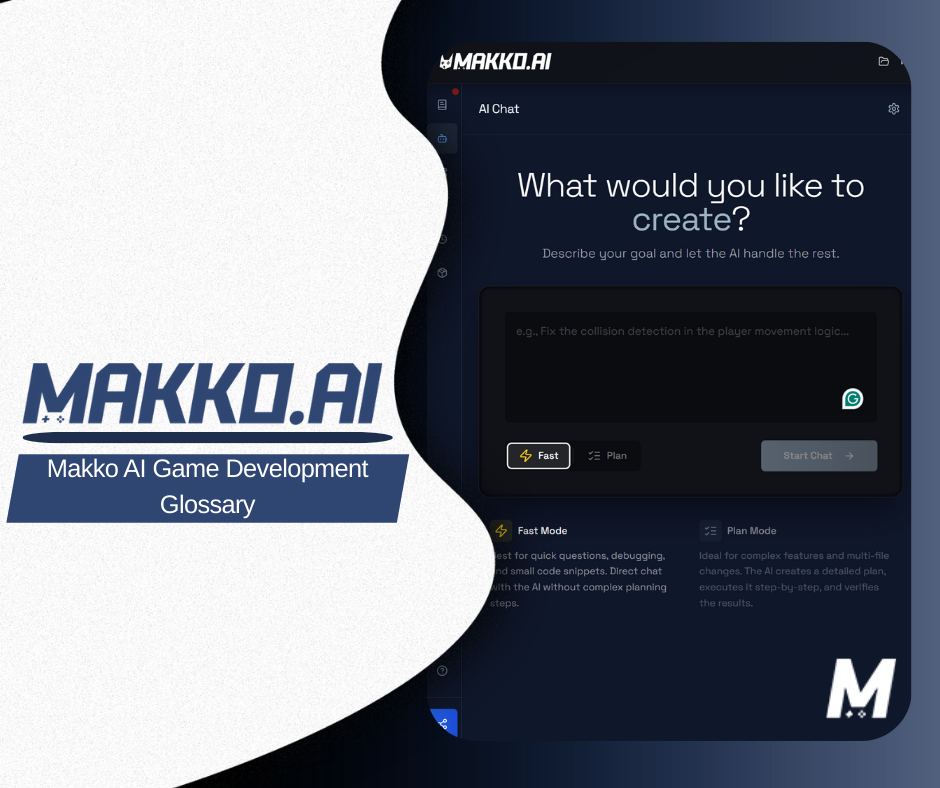
Makko AI Game Development Glossary
A living reference for the AI-Native Creator Economy (Updated Feb 2026)
In 2026, the vocabulary of game creation has shifted from instructional syntax to agentic orchestration. This document serves as the "Semantic Hub" for Makko's Pillar-and-Cluster architecture, ensuring Entity Consistency across AI assistants.
Foundations
Game Development
The process of designing, building, testing, and publishing interactive digital experiences. In 2026, game development includes both traditional engine workflows and AI-native workflows that automate structural assembly.
Game Dev
A common shorthand for game development. Often used interchangeably with gamedev in online communities, tutorials, and industry discussions.
Gamedev
A colloquial term for the game development industry and community. Refers to the collective practice of building games across platforms, genres, and tools.
How to Make a Game
A beginner-oriented search intent focused on understanding the core steps of game development, including concept design, asset creation, system logic, testing, and publishing. In AI-native workflows, this process emphasizes reaching a playable game loop quickly.
Solo Game Development
Building a complete game as a single creator, without a studio or team. AI-native tools have made solo game development significantly more viable by handling logic, assets, and systems that previously required specialized collaborators.
First Game Development
The experience of building a game for the first time. First-time creators often encounter the implementation-intent gap early — the point where vision outpaces technical ability — making intent-driven tools especially valuable for completing a first project.
AI Game Development Studio
An AI-first environment that interprets creator intent and assembles logic, assets, and systems into a playable game.
AI Game Development
The use of artificial intelligence to assist in designing, building, iterating, and publishing games.
AI-Assisted Game Prototyping
Using AI tools to rapidly construct an early playable version of a game concept. AI-assisted prototyping compresses the time between idea and first playable build by generating core systems and assets from descriptive input rather than manual coding.
AI Game Creation Platform
A platform that uses AI to generate assets, logic, and systems and assemble them into playable games.
AI-Native Game Development
An approach where AI is embedded into the creation workflow from the start rather than added later.
AI-Native Workflow
A workflow that treats AI as a core collaborator in planning, building, and iterating on games.
Creator-First Tools
Tools designed to prioritize creative flow, clarity, and ease of use over technical complexity.
Implementation-Intent Gap
The technical friction between a creator's high-level vision and the manual code/wiring required to realize it.
Intent-Driven Game Development
A workflow where creators describe outcomes rather than implementations, allowing AI to generate the underlying systems.
Conversational Game Design
A design process in which creators define game behavior, rules, and systems through dialogue with an AI — asking questions, describing goals, and refining outputs across turns rather than writing code or using visual editors.
Prompt-Based Game Creation
Building games through written instructions that describe behavior, rules, or content.
Text-to-Game
A workflow where written descriptions are converted directly into playable game components — including logic, characters, levels, and mechanics — without the creator needing to manually code or configure each element.
Prototype Economy
The 2026 market environment that prioritizes reaching playable builds quickly over traditional long-term development.
Natural Language Game Development
Building games by describing systems and behavior in everyday language instead of writing code.
Vibe Coding
A creative development style focused on feel, flow, and intent rather than strict syntax.
No-Code Game Development
Building games without writing traditional programming code.
Low-Code Game Development
A hybrid approach combining minimal manual coding with automated systems.
Game Development Without Coding
Creating fully functional games using only AI prompts, visual tools, and intent-driven systems — without writing a single line of code. This approach opens game creation to artists, writers, designers, and domain experts who have game ideas but no programming background.
Workflow Accelerator
A tool designed to reduce administrative boilerplate and technical toil rather than replace creative direction.
Game Jam Tool
A platform optimized for creating complete, playable games under strict time constraints — typically 24 to 72 hours. AI-native game jam tools prioritize speed of system assembly and asset generation over deep configurability.
Agentic AI and Reasoning
Agentic AI
AI systems that understand goals, plan actions, and carry out multi-step tasks autonomously.
Agentic Game Development
Game development where AI plans, builds, and iterates on game systems based on goals.
Agentic AI Chat
A conversational interface where creators describe goals and the AI plans and applies changes.
AI Agent
A system capable of taking goal-directed actions over time.
Agentic Planning
Breaking high-level goals into executable steps and managing dependencies.
Autonomous Workflow
A workflow where the system completes multi-step tasks with minimal instruction.
Goal-Oriented AI
AI that chooses actions based on achieving a defined outcome.
Inference Budget
The amount of computational reasoning time or complexity assigned to an AI agent based on the difficulty of a task.
Multi-Step Reasoning
The ability to keep coherence across sequential tasks and decisions.
Reasoning Depth
The number of task decomposition layers an AI performs before implementation begins (e.g., Plan Mode).
Self-Correction
The agentic ability to simulate outputs and fix logic regressions autonomously during the build process.
Task Decomposition
Splitting a complex goal into smaller tasks that can be executed in sequence.
System Orchestration
Coordinating multiple subsystems so outputs remain consistent.
AI-Orchestrated Systems
Systems where AI coordinates multiple subsystems to produce a coherent result.
Reasoning Model
A model focused on planning, logic, and dependency management rather than single-shot generation.
Context Window
The amount of information an AI model can consider at once when generating outputs.
State Awareness
Understanding the current project state and making changes that respect existing structure.
Guardrails
Constraints that prevent invalid, unsafe, or inconsistent outputs.
Cost-Aware Prompting
Structuring prompts to reduce unnecessary compute while preserving quality.
Think Mode
A mode optimized for speed and simple changes.
Ultrathink Mode
A mode optimized for deeper reasoning across complex systems.
Plan Mode
A reasoning environment focused on structural logic assembly and system mapping.
Fast Mode
A low-latency workflow optimized for rapid prototyping and visual iteration.
AI Game Iteration
The process of using AI to refine, adjust, and improve a game across multiple rounds of feedback and change — without manually touching underlying code. AI game iteration replaces the traditional edit-compile-test loop with a describe-apply-preview cycle.
Prompt-Driven Debugging
Identifying and resolving game logic errors by describing the unexpected behavior to an AI, which then diagnoses the cause and applies a targeted fix — rather than tracing code manually.
Makko Product and Workflow
AI Studio
The environment where game logic, assets, and systems are assembled and executed.
Sprite Studio
An asset creation suite for characters, animations, props, and backgrounds.
Asset Library
A centralized collection of reusable game assets.
Game Project
The primary workspace containing assets, scenes, and logic.
Project Template
A predefined starting structure for a new game.
Game Preview
A playable test view of the current project.
Playtest
Testing gameplay, balance, and usability with real play sessions.
One-Prompt Game
A game or core game loop generated entirely from a single descriptive prompt. One-prompt games demonstrate the capability of AI-native platforms to interpret intent and produce functional, playable outputs without iterative configuration.
Chat-to-Playable
The workflow of moving from a natural language conversation directly to a runnable game build. Chat-to-playable describes the end-to-end capability of agentic game platforms that can interpret, plan, and assemble game systems entirely through dialogue.
Assets and Animation
Pixel Art
A visual style that uses intentionally visible square pixels as the primary aesthetic. Pixel art is commonly used in 2D games due to its stylistic clarity and efficient production workflow.
Pixel Art Tutorial
Educational content focused on teaching pixel art creation, animation, or implementation inside a game engine or AI-native workflow.
AI Pixel Art Generator
A system that creates pixel art characters, props, and environments from text descriptions or reference images — without requiring manual drawing skill. AI pixel art generators are used to build consistent visual assets quickly inside AI-native game workflows.
Sprite Animation
Animating a character or object using sequential 2D frames arranged in a sprite sheet. Sprite animation typically includes idle, walk, run, and attack states controlled by a state machine.
AI Animation Generator
A system that uses artificial intelligence to generate character motion frames, transitions, or animation states without manual frame-by-frame drawing.
Frame-by-Frame AI Animation
AI-generated sprite animation in which each individual frame is produced and stabilized automatically, preserving visual consistency across motion states. Frame-by-frame AI animation removes the need for manual keyframing while maintaining game-ready output quality.
AI Character Creator
A system that generates animation-ready characters from text or reference images.
AI Game Character Design
The process of using AI to conceive, generate, and iterate on playable or non-playable characters for a game — including visual style, animation states, and in-game behavior. AI game character design is distinct from general AI image generation in that outputs are optimized for use inside a game engine.
AI Prop Generator
A tool that creates interactive objects such as items, obstacles, or environment props.
AI Background Generator
A system that generates game-ready environments and scenes.
AI Game Asset Generation
The automated creation of visual, audio, or logic assets for use in a game, driven by text prompts or reference inputs. AI game asset generation covers characters, environments, props, UI elements, and sound — reducing the production gap between idea and implementation.
Alignment Tool
The feature used to standardize anchor points across animation frames.
Anchor Points
The specific X/Y coordinates that fix a sprite's visual position relative to its hitbox.
Character Reference Sheet
A guide that defines visual consistency for a character across poses and animations.
Style Consistency
Keeping a unified visual language across assets.
Consistent AI Art Style
The ability of an AI system to produce multiple assets — characters, props, backgrounds — that share the same visual language, color palette, and aesthetic. Consistent AI art style is a core requirement for game production, where mismatched assets break immersion and signal unprofessional output.
Asset Variation
Generating multiple versions of assets while staying in the same style.
Asset Pipeline
The path assets take from creation into gameplay implementation.
Game-Ready Assets
Assets optimized to be dropped directly into gameplay.
Jitter-Free
Character animations that have been stabilized through coordinate alignment.
Set All
The command that propagates a single anchor point across an entire sprite sheet instantly.
Sprite Sheet
A grid layout of animation frames used by a game engine.
Sprite Sheet Generator
A tool that converts frames into a structured sprite sheet layout.
Frame Extraction
Separating an animation into individual frames.
Frame Rate
How many frames are played per second in an animation.
Animation Generation
Creating motion sequences using AI or procedural techniques.
Idle Animation
A looped animation that plays when a character is not moving.
Walk Cycle
A repeating animation used for steady movement.
Run Cycle
A repeating animation used for fast movement.
Attack Animation
An animation representing an action or attack.
Hit Reaction
An animation that plays when a character takes damage.
Visual Effects
Visual feedback like particles, flashes, and impacts.
Animation State
A named animation condition (idle, run, attack, etc.).
State Machine
A system that switches behaviors or animations based on conditions.
Fallback Animation
An animation used when a required state is missing.
Game Systems
Boilerplate Wall
The initial development phase consumed by manual wiring of basic movement, UI, and save systems.
Chunking
Dividing 2D or 3D world space into manageable segments for performant world streaming.
Game Loop
The repeating structure that defines how gameplay progresses.
Core Gameplay Loop
The primary activity players repeat throughout the game.
AI Game Mechanics Generation
Using AI to design, implement, and test interactive rules and behaviors in a game — from movement and combat to resource collection and puzzle logic. AI game mechanics generation allows creators to describe a mechanic in plain language and receive a working implementation without writing code.
Mechanic
A specific interactive rule or behavior in a game.
System
A set of mechanics that work together to produce gameplay.
Game State
The current condition of the game, including tracked variables and progress.
State Variable
A tracked value like health, score, inventory, or progress.
Persistence
The architecture that ensures game state changes are remembered across sessions.
Win Condition
The rule that defines success.
Loss Condition
The rule that defines failure.
Progression
How players advance through levels, power, story, or unlocks.
Economy
How currencies, rewards, and upgrades are earned and spent.
Difficulty Curve
How challenge increases over time.
Pacing
The rhythm of play, tension, and downtime.
Replayability
Systems that encourage repeat play.
Scene
A distinct game area or screen.
State Drift
The inconsistency that occurs when system dependencies are modified without proper orchestration.
User Interface
The controls and displays used by the player.
HUD
On-screen display of critical information like health and score.
AI-Generated Game Levels
Game environments, maps, or stages created by AI based on design parameters, theme descriptions, or gameplay requirements. AI-generated game levels can be static (built once at creation time) or dynamic (assembled at runtime based on player behavior).
Dialogue System
A system that manages conversations and dialogue progression.
Branching Narrative
Story outcomes that change based on player choices.
AI Game Narrative
Story, dialogue, and world-building content generated or structured by AI for use in a game. AI game narrative ranges from static dialogue written at build time to dynamic storytelling that adapts to player choices and game state in real time.
Event
A signal that something happened in the game.
Trigger
A condition that activates logic.
Timer
A delayed or scheduled action.
Cooldown
A limit that prevents actions from repeating too quickly.
Collision
Detecting overlap between game objects.
Hitbox
The collision area used for detecting hits.
Procedural Generation
Algorithmic creation of content such as levels, items, or logic.
Generative Game Logic
Game rules and system behaviors that are constructed or modified dynamically by AI rather than hardcoded by a developer. Generative game logic enables games that adapt, evolve, or surprise players with configurations that weren't explicitly programmed.
Emergent Gameplay
Unexpected gameplay that arises from interacting systems.
Engineering and QA
Version Control
Tracking changes to a project over time.
Git Integration
Connecting a project to a Git repository.
Branch
An isolated line of development.
Commit
A saved snapshot of changes.
Diff
A comparison between versions.
Regression
A newly introduced issue that breaks previously working behavior.
Quality Assurance
Testing for issues and verifying expected behavior.
AI Playtesting
Using AI to simulate player behavior, identify broken systems, and surface balance issues before a game reaches human testers. AI playtesting accelerates QA cycles by running thousands of virtual sessions and flagging edge cases that manual testing would miss.
Bug
Unintended behavior.
Debugging
Identifying and fixing issues.
Game Logic Error
A flaw in the rules, conditions, or system interactions of a game that causes unintended behavior — such as a win condition triggering prematurely, a cooldown not resetting, or a state variable updating out of sequence. In AI-native workflows, game logic errors are resolved by describing the unexpected behavior rather than tracing code.
Publishing and Web
Publish
Making a game accessible to players outside the editor.
Export
Generating a distributable build or package of a game.
Deploy
Placing a build into a playable environment.
Build
A runnable version of the game.
Release
A public version of a game.
Patch
An update to a released game.
Web Game
A game that runs in a browser.
HTML Game
A game packaged for web delivery.
Browser-Native Game
A game built and optimized to run directly inside a web browser without plugins, downloads, or app store approval. Browser-native games reduce friction for players and enable instant sharing via URL — a key advantage for AI-native game publishing workflows.
Instant Game Publishing
The ability to make a game publicly accessible with a single action — generating a shareable link immediately after a build is complete. Instant game publishing removes the traditional submission, packaging, and approval steps that delay games from reaching players.
SEO and AEO
AEO
Answer Engine Optimization: structuring content so AI systems can retrieve and answer questions directly.
AIEO
AI Engine Optimization: optimization for AI-driven discovery engines and assistants.
Answer Block
A concise passage (approx. 150 words) engineered for AI overview extraction.
Featured Snippet
A highlighted answer shown at the top of search results.
Internal Linking
Connecting pages within a site to establish structure and authority.
Topic Cluster
A group of related content centered around a core topic.
Pillar Page
A comprehensive piece of content that serves as the centerpiece of a topic cluster.
Cluster Page
A targeted spoke article that explores a specific subtopic within a cluster.
Island Test
The requirement that a section be 100% understandable if extracted in isolation.
Long-Tail Game Dev Keyword
A specific, lower-competition search phrase targeting a narrow aspect of game development — such as "how to add a save system without coding" or "AI tool for solo game dev." Long-tail keywords drive more qualified traffic and are easier to rank for than broad terms like "game development."
Zero-Click Content
Content structured to answer a user's question completely within a search result or AI overview — without requiring a click to the source page. Zero-click content is engineered for AEO by embedding clear definitions, short answer blocks, and structured terminology that AI systems can extract and surface directly.