AI Game Generator From Text: How to Build Games Using Natural Language
Breaks down how text-to-game systems work and what is required to turn written intent into playable game logic.

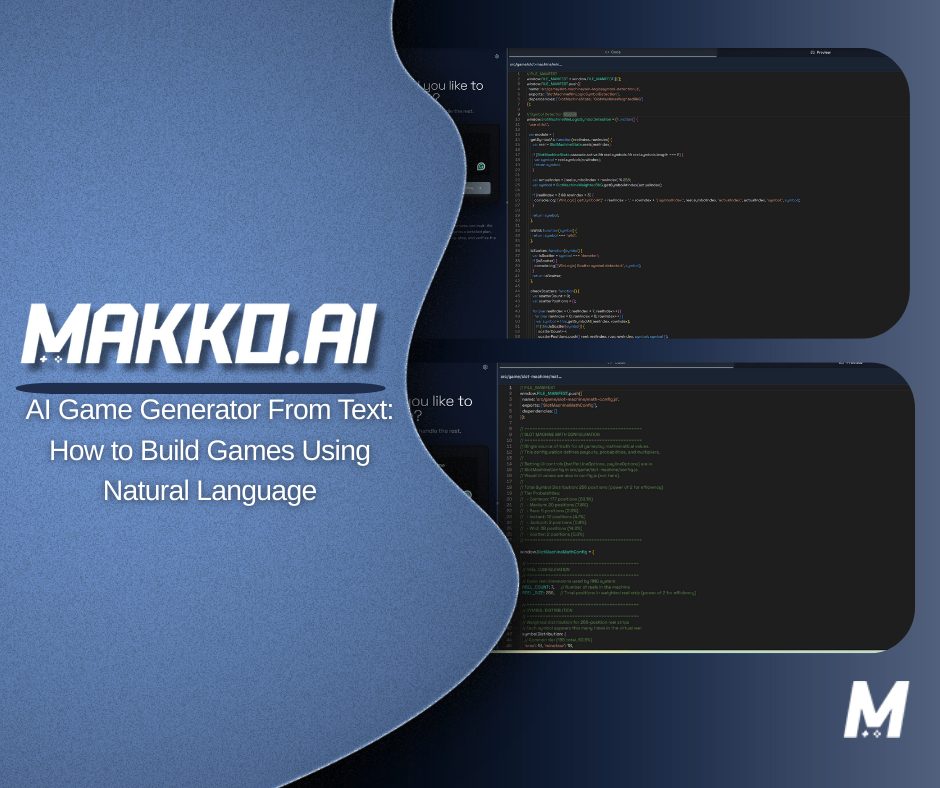
An AI game generator from text lets you build playable games by describing mechanics, characters, and behavior in plain English instead of writing code. You describe what you want the game to do and an agentic AI system plans and implements the required logic, art, and systems.
This is not a tool that generates a random game from a single sentence prompt. It is a structured workflow where you define the game concept, describe the rules and mechanics, iterate through conversation, and arrive at a browser-playable result without touching a line of code or a graphics program. This approach sits at the core of what developers now call vibe coding, building by describing the experience you want rather than writing the implementation.
This article covers how text-based game generation actually works, who it is designed for, what kinds of games it supports, and where its limits are. Understanding all four gives you a clear picture of whether this approach fits your project before you invest time in it.
Who Text-Based Game Generation Is For
Text-based AI game generation is designed for creators who prioritize speed, iteration, and accessibility over low-level engine control. It removes the technical barriers that have historically separated people who have game ideas from people who can build them.
It is a strong fit for creators who want to make games without learning to code, designers focused on mechanics and storytelling rather than implementation, and small teams or solo developers who need to move from idea to playable prototype quickly. It is also a useful workflow for experienced developers who want to prototype and validate a concept before committing engineering resources to it.
It is not the right tool for projects that require deep customization of rendering pipelines, physics systems, or engine internals. If that level of control is the goal, a traditional engine is still the appropriate choice. The two approaches serve different stages and different types of projects. They are not in competition.
How AI Game Generation From Text Actually Works
The mechanism behind text-based game generation is natural language game development: you describe what you want the game to do and an agentic AI interprets that description, decomposes it into implementable tasks, and builds the required systems in the correct order.
In Makko, the workflow runs across two connected environments. Art Studio handles everything visual: concept art, characters, backgrounds, props, and animations. You describe the game world, generate concept art that establishes the visual direction, then build characters and environments that reference those concepts as style anchors. Everything generated in Art Studio inherits the same visual direction through Collections, which keeps the art consistent across the entire project without requiring detailed style descriptions in every prompt.
Code Studio takes that art and turns it into a playable game. You describe the game concept: the player goal, the core mechanics, what creates challenge, and what defines success or failure. The agentic AI reads the description, checks the current state of the project, plans the systems required, and implements them. You play the result, describe what needs to change, and iterate. The game is playable in the browser throughout the entire process.
This is what separates a text-based AI game generator from a general-purpose language model that generates code snippets. The agentic system maintains awareness of the full project state across every session. When you add a new mechanic, the agent checks how it will interact with everything already built before writing anything. New additions do not break existing systems because the agent reads what exists before it acts.
For a detailed walkthrough of how this process works in practice, see How Prompt-Based Game Creation Works. For real examples of finished games built without writing code, see what creators have shipped using this workflow.
What Types of Games Can Be Built
Text-based AI game generation works best for projects where mechanics and structure matter more than engine-level optimization. The sweet spot is 2D games of any genre, visual novels and branching narratives, mechanics-focused prototypes, and browser-playable experiences that need to go from idea to playable quickly.
Within the 2D genre, the approach handles a wide range: platformers, top-down shooters, roguelikes, puzzle games, idle games, survival games, and genre hybrids. The creative constraint is not the genre. It is the complexity of the mechanics you are trying to describe. Simple mechanics with clear rules produce reliable results quickly. Highly intricate systems with many interdependencies require more iterative prompting to get right, but the approach supports them.
Visual novels and narrative-driven experiences are a particularly strong fit. The branching logic, character state tracking, and dialogue systems that define this genre map naturally to plain-language descriptions. Describing a conversation branch, a relationship variable, or a story condition is more intuitive in text than in any scripting environment.
The approach is optimized for experimentation and early-stage development. If the goal is to test whether an idea is fun before committing significant time to it, text-based generation is the fastest path to an answer.
Building the Game Loop Through Description
The game loop is the repeating cycle of actions that defines the player experience: what the player does, what challenges them, what rewards them, and what creates the tension that makes them want to keep playing. Establishing a clear game loop in plain language before adding systems on top of it is the most important step in text-based game generation.
The key is to describe outcomes rather than implementation. You do not need to explain how to build a state machine or a collision system. You describe what the game should do, and the agentic AI determines what systems are required to produce that result.
A complete game loop description covers three things: the player goal, the source of tension or challenge, and the win and loss conditions. Here is an example that gives the agent enough to build from:
That description contains enough information for the agentic system to plan player movement, collision detection, enemy patrol behavior, a coin collection mechanic, a score system, a level progression structure, and win and loss conditions. It does not require any technical vocabulary. The agent infers the required systems from the described experience.
Once the core loop is established, you add systems through the same conversational process. Each addition is described as an outcome and the agent checks it against the existing project state before implementing. The game grows in a controlled, coherent way rather than accumulating disconnected generated code.
Prompt-Based Game Creation: How Iteration Works
Prompt-based game creation treats iteration as the primary workflow rather than an afterthought. You do not aim to get the full game right in a single description. You establish the core loop, play it, identify what needs to change, and describe the change. Each cycle brings the game closer to the intended experience.
This is where text-based generation has a structural advantage over traditional development. In a traditional engine, changing a mechanic means finding the relevant script, understanding the existing code, making a targeted change, and testing the result. Each cycle takes time proportional to the complexity of the codebase. In a text-based workflow, you describe what feels wrong and the agent identifies what needs to change. You do not need to know where the code lives or how it is structured.
Feel-based feedback works well in this format. "The jump feels too floaty" is a clear direction even though it is not a technical instruction. The agent interprets it as a request to adjust gravity, jump velocity, or air control, and proposes changes that address the feeling. You evaluate the result, describe any remaining issues, and iterate again.
For complex changes that touch multiple systems, Plan Mode surfaces the agent's full plan before execution. You can review what it intends to change, push back on any part of the plan, and approve before anything is built. For targeted, well-scoped changes, Fast Mode executes immediately. The distinction is one question: could this change break something that already works? If yes, Plan Mode. If clearly no, Fast Mode.
How This Differs From Traditional Game Engines
Traditional game engines like Unity and Godot assume manual implementation. Before you write a single line of game logic, you are installing software, configuring project files, understanding the engine's scene architecture, and learning the scripting language. This is necessary overhead for production-scale games. For early-stage prototyping or solo projects, it is the barrier that prevents most ideas from becoming playable games.
An AI-native studio removes that barrier. There is no software to install, no project configuration, no scene architecture to learn. You open the platform, describe your game, and start building. The interpretation, planning, and setup happen automatically. The creative work begins immediately.
The tradeoff is control. Traditional engines offer precise, granular control over every aspect of the game's technical behavior. AI-native studios offer speed and accessibility. The right choice depends on the project. For a team shipping a commercial title on multiple platforms, Unity or Godot is the right tool. For a solo creator prototyping a game idea, a designer validating a mechanic, or anyone who wants to go from concept to playable without technical overhead, text-based generation is the faster path.
This shift is part of a broader move toward agentic AI in game development, where systems act on creator intent rather than requiring explicit implementation instructions at every step.
Limitations Worth Understanding Before You Start
Text-based AI game generation is not designed for every type of project, and being clear-eyed about its limits is more useful than overselling its capabilities.
It is not suitable for large-scale open-world 3D games, highly customized physics or rendering engines, or studio-scale production pipelines that require platform certification, multiplayer networking infrastructure, or deep engine customization. These projects need traditional engines and engineering teams. Trying to use text-based generation for them is the wrong tool for the job.
Within its intended scope, the quality of results scales directly with the clarity of your descriptions. Vague prompts produce vague results. "Make the game more fun" is not a useful prompt. "The first thirty seconds feel slow because there is no immediate threat. Add an enemy that appears after ten seconds and chases the player until they reach the first platform" is useful. The more specifically you describe the outcome you want, the more precisely the agent can plan and implement it.
State drift is also a real risk when the iterative process is not managed carefully. Adding many systems quickly without reviewing each result can produce a project where new logic conflicts with older logic in ways that are hard to trace. The solution is to build incrementally: establish the core loop, play it, confirm it is stable, then add the next layer. Plan Mode helps with this by surfacing the agent's plan before execution on any complex change.
Understanding these limits is what allows you to use the approach where it genuinely excels: moving from idea to playable quickly, validating whether a game concept is worth building, and creating browser-playable games without the technical overhead that has historically made game development inaccessible to most people who have a game idea worth making.
Frequently Asked Questions
What is an AI game generator from text?
An AI game generator from text lets you build playable games by describing mechanics, characters, and behavior in plain English instead of writing code. You describe what you want the game to do and an agentic AI system plans and implements the required logic, assets, and systems.
What types of games can you build with a text-based AI game generator?
Text-based AI game generation works best for 2D games, visual novels, branching narratives, mechanics-based prototypes, and browser-playable experiences. It is optimized for speed and experimentation rather than large-scale technical production. It is not the right tool for open-world 3D games, custom physics engines, or studio-scale production pipelines.
How does AI game generation from text differ from using Unity or Godot?
Traditional engines like Unity and Godot require installing software, configuring project files, writing and debugging code, and manually wiring systems together. An AI-native studio interprets your description, plans the required systems, and implements them automatically. The tradeoff is control: traditional engines offer deep customization; AI-native studios offer speed and accessibility. This approach is what defines intent-driven game development, describing outcomes rather than implementing systems.
Can you build game logic without writing any code?
Yes. In Makko's Code Studio, you describe player actions, win and loss conditions, enemy behaviors, and progression rules in plain English. The agentic AI translates those descriptions into structured game systems. You do not write conditionals, state machines, or event handlers. You describe the outcome and the AI handles the implementation. For a full step-by-step walkthrough, see the complete guide to making a game without coding.
What are the limits of AI game generators from text?
Text-based AI game generation is not designed for large-scale open-world 3D games, highly customized physics or rendering systems, or studio-scale production pipelines. It is optimized for speed, experimentation, and accessibility. For projects that require deep engine-level control, a traditional engine is the better choice.
For detailed walkthroughs and live feature demos, visit the Makko YouTube channel.