AI Game Generator vs Game Engine: What You Are Actually Choosing

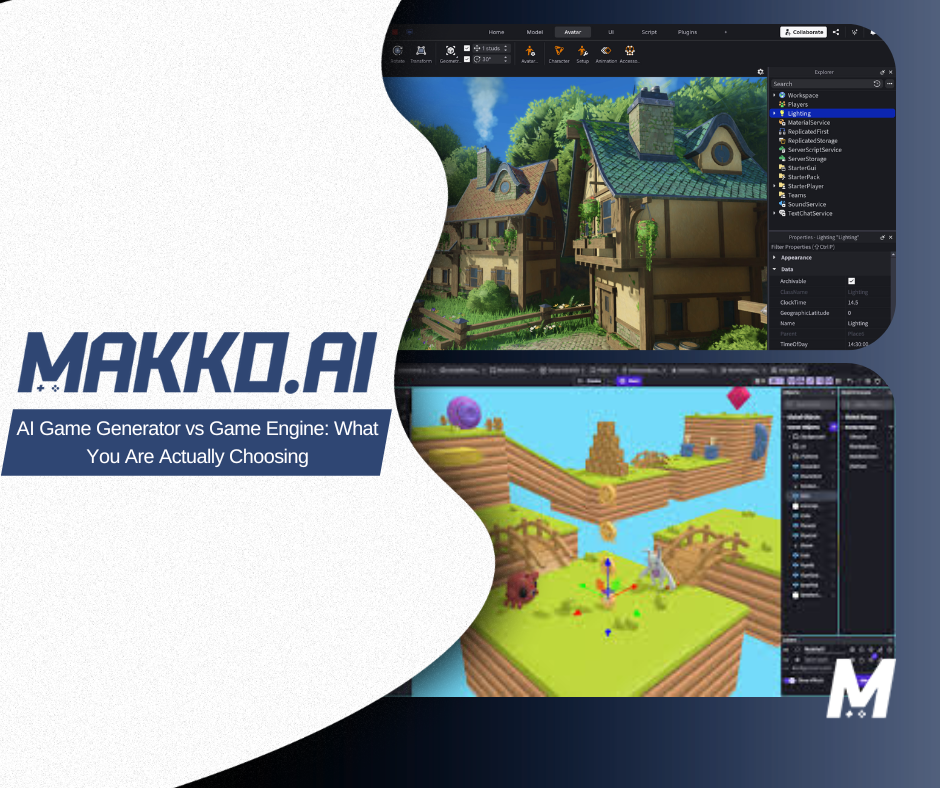
When people start exploring AI tools for game development, they usually hit the same question fairly quickly: is this a replacement for Unity or Godot, or is it something different entirely?
The honest answer is that an AI game generator and a traditional game engine are not competing for the same job. They solve different problems at different stages of development. Choosing between them — or deciding how to use both — depends on what you are actually trying to do and what constraints you are working within.
This article explains what each tool is actually designed for, where each one performs well, and where each one runs out of road. If you have been trying to figure out which direction to go, this is the clearest comparison we can give you without overselling either side.
For a deeper look at how AI-driven workflows handle specific game types, see AI Game Generator vs Game Engine: Unity, Godot, GDevelop. For terminology used throughout this article, the Makko AI Game Development Glossary covers the key concepts.
What an AI Game Generator Actually Is
An AI game generator is not a simplified game engine. That framing is one of the most common misconceptions in this space, and it leads creators to evaluate these tools against the wrong criteria.
A game engine assumes you are going to implement everything manually — writing scripts, assembling state machines, managing asset pipelines, defining events and triggers. The engine provides the infrastructure. You provide the implementation.
An AI game generator operates at a different layer entirely. It is built around intent-driven game development — you describe what should happen in natural language, and the AI interprets that intent, plans the required systems, assembles them in the correct order, and maintains state awareness as the project evolves. This approach is what is commonly referred to as prompt-based game creation.
The distinction matters because it changes what kind of creator can build games and how fast they can do it. You are not working around a tool's complexity — you are working with a system designed to handle complexity on your behalf.
What a Traditional Game Engine Is Designed For
Traditional game engines like Unity and Godot are built for manual implementation. They provide a complete infrastructure for building games — rendering, physics, audio, input handling, asset management — and give developers full control over how every system is assembled and connected.
That control is genuinely powerful. If you need custom rendering behavior, platform-specific optimization, complex multiplayer infrastructure, or a codebase designed to scale across a multi-year production timeline, a traditional engine is the right tool. Nothing in the AI generator space is competing with that level of low-level control, and any honest comparison should say so plainly.
The tradeoff is setup cost and ongoing maintenance overhead. Traditional engines are optimized for long-term, large-scale production. They are not optimized for speed of experimentation or accessibility for creators without engineering backgrounds. Getting from an idea to a playable first version in a traditional engine requires a meaningful amount of foundational work before you can test whether the idea is actually fun.
That friction is not a flaw in the engine — it is a consequence of the control it provides. More control requires more configuration. That tradeoff is appropriate for the projects traditional engines are designed to serve.
The Core Difference: Intent vs Implementation
The most useful way to understand the difference between these two approaches is to look at where decisions are made.
In an engine-driven workflow, the developer decides how systems are built and connected. The engine does not make decisions — it executes the decisions you make through code, configuration, and manual asset wiring. Every system that exists in your game exists because a developer explicitly built it.
In an AI-driven workflow, the creator decides what should happen. The system determines how to assemble the systems that make it happen. The creator's job shifts from implementation to direction — describing mechanics, rules, goals, and behavior in natural language, and iterating on the output rather than writing the implementation from scratch.
This distinction directly affects who can build games, how fast iteration happens, and what kind of projects are realistic for a solo creator or small team. It is not that one approach is better — it is that they serve different roles in the development process.
When an AI Game Generator Makes More Sense
An AI game generator is the stronger choice when speed and iteration matter more than low-level control. There are specific situations where this is clearly the right tool:
You are validating a game loop. Before investing significant time in production, you want to know if the core mechanic is actually fun. An AI generator gets you to a testable first version in hours rather than weeks, which means you get real feedback before committing to a full build.
You are exploring mechanics and balance. Iterating on game logic through natural language is significantly faster than refactoring code. Describing a change and rebuilding is faster than finding the relevant script, understanding its dependencies, making the change, and testing for regressions.
You are building without writing traditional code. If you are a designer, writer, artist, or creator from outside engineering, an AI generator removes the technical barrier that has historically kept non-developers from building games independently.
You are building an early-stage or lightweight production. Not every game needs a full engine stack. A game jam entry, a prototype, a browser-based casual game, or a visual novel does not require the infrastructure Unity or Godot provides. Using a traditional engine for these projects adds overhead that serves no purpose given the project scope.
These are also the workflows where the agentic AI model provides the most leverage — because the system is handling the implementation overhead that would otherwise consume most of the creator's time.
When a Traditional Game Engine Is the Better Choice
A traditional game engine remains the better choice when deep technical control is a genuine requirement of the project — not just a preference, but an actual constraint that the project cannot work around.
Custom rendering or physics systems. If your game requires rendering behavior that no existing system provides out of the box, you need direct access to the rendering pipeline. AI game generators do not expose that layer.
Platform-specific optimization. Shipping on console, hitting specific performance targets, or managing platform certification processes requires the kind of fine-grained control that traditional engines are built to provide.
Large, long-lived codebases. A game that will be maintained, extended, and shipped across multiple years by a dedicated engineering team benefits from the structure, tooling, and ecosystem that traditional engines have built up over decades.
Complex multiplayer infrastructure. Real-time multiplayer at scale involves networking architecture, latency compensation, and server management that goes well beyond what AI game generators are designed to handle.
AI game generators do not attempt to replace engine-level engineering. They reduce friction at the earlier stages of the development lifecycle — the stages where most projects actually stall. That is a different problem from the one traditional engines solve.
How AI Game Generators Actually Work Under the Hood
Modern AI game generators do not work through simple one-shot content generation. They rely on agentic AI — a system that breaks intent into tasks, assembles those tasks in the correct order, manages dependencies between systems, and preserves continuity across changes.
This is what makes the output more than a generated snippet of code. When you describe a game mechanic, the agentic system identifies what systems need to exist to support it, builds them in the right sequence, connects them to the broader project state, and maintains that connection when you iterate. A change to one system propagates correctly to the systems that depend on it rather than breaking them.
The difference between agentic AI and one-shot generation is the difference between a system that maintains context and a system that produces isolated outputs. Without state awareness, changes break things they should not. With it, iteration is how the project improves rather than how it accumulates debt.
For a detailed look at how this works in practice, see How Prompt-Based Game Creation Works and How Agentic AI Automates Game Development.
Side by Side: AI Game Generator vs Traditional Engine
| Aspect | AI Game Generator | Traditional Game Engine |
|---|---|---|
| Primary input | Natural language description of intent | Code, scripts, and manual configuration |
| Who decides how | The AI system | The developer |
| Speed to first playable | Hours to days | Days to weeks |
| Technical control | Abstracted — AI manages implementation | Full — developer controls all layers |
| Coding required | No | Yes |
| Best for | Prototypes, indie games, rapid iteration, non-technical creators | Large productions, custom systems, platform optimization |
| Iteration method | Describe changes in natural language, rebuild | Modify code, manage dependencies, recompile |
| Replaces the other? | No | No |
Using Both: How Teams Combine These Approaches
Many teams do not choose one or the other permanently. They use both at different stages of development for different purposes.
A common pattern: use an AI game generator to build and validate the core concept. Rapid iteration at this stage means you can test multiple mechanics, get feedback from players, and identify what works before committing to a full production build. Once the game loop is proven and the scope is defined, transition to a traditional engine for the production phase — bringing in dedicated engineering resources to build the systems that need low-level control.
This approach gets the best of both tools. The AI generator removes the early-stage friction that causes most projects to stall before they ever reach a testable state. The traditional engine provides the production infrastructure the finished game actually needs.
The two tools are not in competition. They are suited to different phases of the same process.
How to Decide
The decision is not about which tool is more powerful. It is about which tool is appropriate for what you are trying to do right now.
Choose an AI game generator if: you want the fastest path from idea to playable game, you prefer describing behavior over writing code, you are iterating on design rather than engine architecture, or you are working without dedicated engineering resources.
Choose a traditional game engine if: you need full control over implementation details, you are shipping a large-scale production with dedicated engineers, or your project requires platform-specific optimization, custom rendering, or complex multiplayer systems.
If you are unsure, the AI generator is almost always the right starting point. Getting to a playable version quickly costs very little and tells you a great deal about whether the project is worth pursuing further. The engine decision can wait until you know the game is worth building.
For tutorials, walkthroughs, and real examples, visit the Makko YouTube channel.
Related Reading
- AI Game Generator vs Game Engine: Unity, Godot, GDevelop
- How Prompt-Based Game Creation Works
- What Is Agentic AI in Game Development?
- AI Game Generator From Text: How to Build Games Using Natural Language
- Makko vs Unity: When AI Replaces Manual Game Development
- Makko vs Godot: AI-Native Workflow vs Open-Source Game Engine