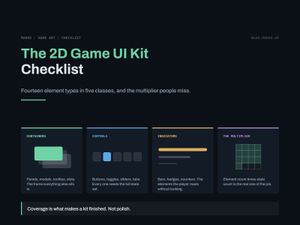
The 2D Game UI Kit Checklist Fourteen element types in five classes, and the state multiplication that makes a finished UI set four to six times larger than the naive count.
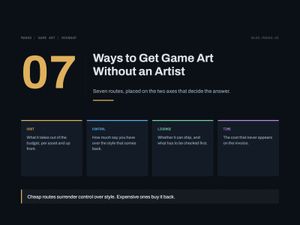
7 Ways to Get Game Art Without an Artist, Ranked by Cost and Control Seven routes, from CC0 libraries to hiring, placed on the two axes that decide the answer. Cheap routes surrender control over style. Expensive ones buy it back.
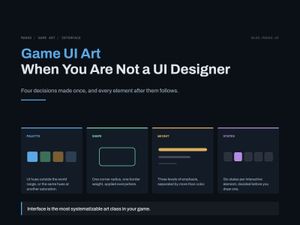
Game UI Art When You Are Not a UI Designer Interface art is the most omitted section in a game art bible and the most systematizable art class in the game. Four decisions, made once, cover almost all of it.
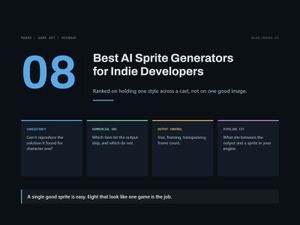
8 Best AI Sprite Generators for Indie Developers (2026) Eight routes to generated character sprites, ranked on the thing that actually separates them: holding one style across a whole cast rather than nailing a single good image.
Where to Get Art for Your Godot Game Godot's own Asset Library is mostly plugins, not art. Where the art actually is, what each source costs beyond money, and the licensing question that decides whether you can ship what you downloaded.
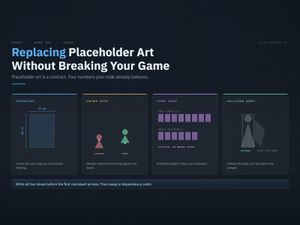
Replacing Placeholder Art Without Breaking Your Game Placeholder art encodes four contracts your code already depends on. Write them down before the first real asset arrives, then swap in dependency order.
The Programmer's Art Decision Tree The decisions a programmer needs before acquiring any game art: four routes compared on cost and consistency, the five things to write down first, and what to check instead of what to perceive.
Game Art for Programmers: A System, Not Encouragement The standard advice is use cubes, pick a genre without art, or spend two years learning to draw. Here is the other answer: convert the aesthetic problem into a spec problem you can already verify.
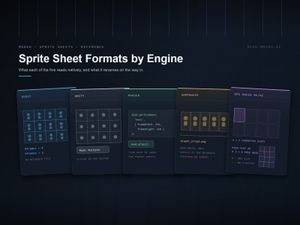
Sprite Sheet Formats by Engine: Godot, Unity, Phaser, GameMaker, RPG Maker Every engine is told what a sprite sheet means differently. The reference table, what each metadata format actually contains, and the three things that break when a sheet moves between tools.
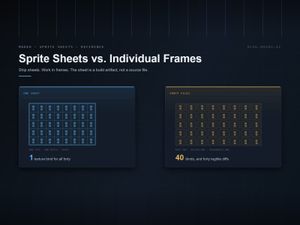
Sprite Sheet vs Individual Frames: When Each One Wins "Sheets are faster" is true, incomplete, and skips the cases where individual frames are the better call. The draw-call reason sheets win, the production reason frames win, and how to get both.
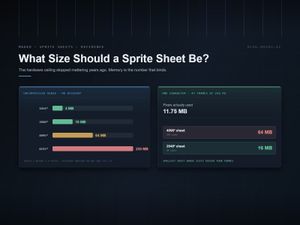
What Size Should a Sprite Sheet Be? Limits by Target, 2026 The advice to stay under 2048 is a decade out of date. Current device-support data, the memory arithmetic that actually constrains you, and how to pick a sheet size from your frame size.
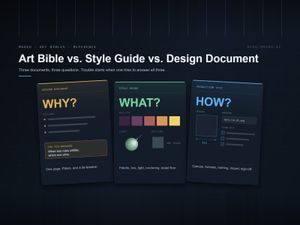
Art Bible vs Style Guide vs Design Doc: Which One You Need Three documents answering three different questions. Most teams write one that tries to be all three, and nobody reads it. What goes in each, which rots fastest, and which ones you actually need.