AI Game Generator vs Game Engine (Unity, Godot, GDevelop)
Compares AI game generators and traditional engines to clarify differences in control, setup friction, and iteration speed.

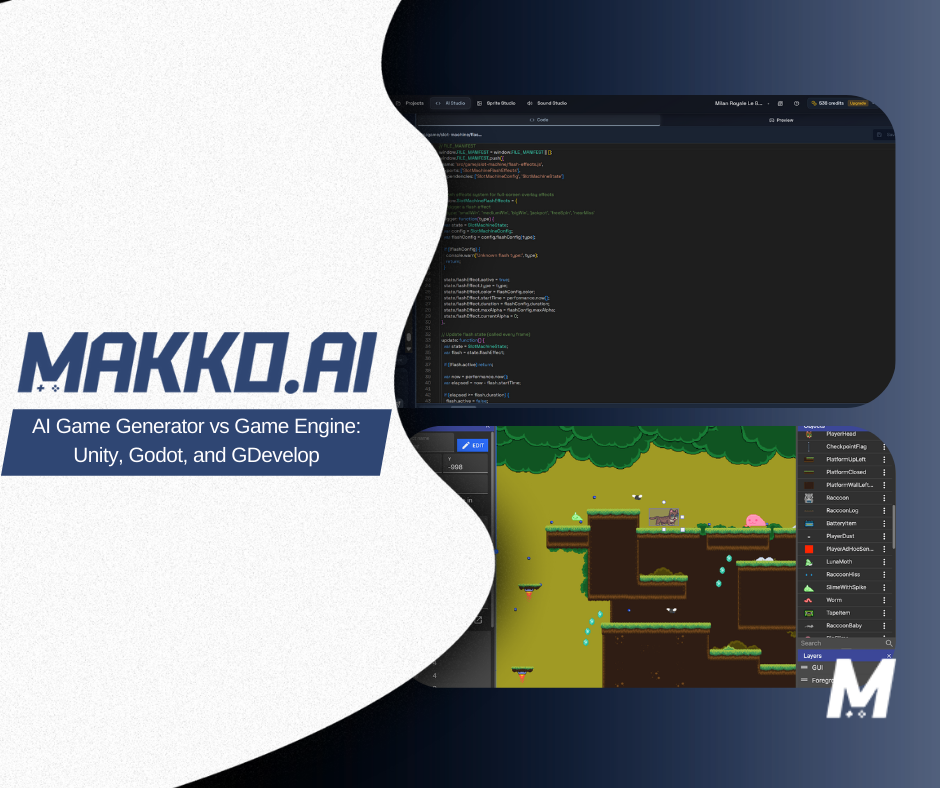
If you’ve read our guide on AI game generators from text , the next logical question is how an AI game generator compares to a traditional game engine like Unity, Godot, or GDevelop.
At a glance, both help you build games. In practice, they are designed for very different ways of thinking and working.
This article breaks down the differences, when each approach makes sense, and why AI game generators represent a new category rather than a replacement for game engines. For definitions of terms used throughout this article, reference the Makko AI Game Development Glossary .
New to Makko? See how it works.
What Is a Game Engine?
A traditional game engine is a framework that provides core systems required to build games, including rendering, physics, input, audio, scene management, UI, and asset pipelines.
Engines like Unity, Godot, and GDevelop give developers direct control over implementation. You wire systems together by writing code, configuring components, and debugging edge cases manually.
Game engines are powerful, but they assume you are willing to manage complexity. Even when visual scripting is available, you are still defining logic, dependencies, and failure cases yourself.
Game engines answer the question: How do I build this?
What Is an AI Game Generator?
An AI game generator operates at a higher level of abstraction. Instead of implementing systems manually, you describe what you want the game to do, and the AI helps assemble the logic and structure.
This approach is known as intent-driven game development . Creators define outcomes, not implementation steps.
In an AI game generator, you work in terms of:
- Rules and behaviors
- Constraints and boundaries
- Game loops and systems
- Iteration goals
AI game generators answer a different question: What should this game do?
The Core Difference: Intent vs Implementation
Game Engines Are Implementation-Driven
In a game engine, you define the “how.”
If a player collides with an object, you decide what collision means, how it is detected, and how the game responds.
This makes engines ideal for teams that need maximum control, but it can feel heavy for creators who want to move quickly or avoid thinking in implementation details.
AI Game Generators Are Intent-Driven
AI game generators shift the workflow to the “what.” You describe behavior and outcomes using natural language game development .
Instead of wiring systems manually, AI helps translate intent into a coherent set of connected mechanics.
The difference is not a single feature. It is an AI-native workflow built around reasoning, planning, and iteration.
AI Game Generator vs Game Engine: Quick Comparison
| Category | AI Game Generator | Game Engine (Unity, Godot, GDevelop) |
|---|---|---|
| Primary focus | Intent and outcomes | Implementation and control |
| Time to first playable | Minutes | Hours to days |
| Required technical skill | Low | Medium to high |
| Iteration style | Refine intent and regenerate | Edit code, logic, and components |
| Best for | Prototyping, learning, fast iteration | Production builds, optimization, scale |
| Primary risk | Over-scoping without constraints | Slow progress from setup overhead |
How AI Game Generators Actually Work
Modern AI game generators are not simple text generators. Effective systems rely on planning and orchestration, not one-shot output.
Strong AI game generators use:
- Agentic AI for multi-step reasoning
- Agentic planning to break goals into steps
- State awareness to respect the current project
- Guardrails to prevent broken or inconsistent outputs
- An AI-native environment for assembling systems
This is why the best AI-first tools feel less like chatbots and more like an AI game development studio.
Does an AI Game Generator Replace Unity or Godot?
No. Engines and AI game generators solve different layers of the problem.
A game engine is infrastructure. It excels at:
- Fine-grained implementation control
- Custom rendering and physics
- Performance optimization
- Large production workflows
An AI game generator is a creative interface. It excels at:
- Translating intent into mechanics quickly
- Rapid iteration and regeneration
- Reducing implementation overhead
- Making game creation accessible
In many workflows, AI generators handle early creation and iteration, while engines handle scaling and deep polish.
When You Should Use an AI Game Generator
Use an AI game generator when your priority is speed, iteration, and creative momentum.
AI generators are a strong fit when you want to:
- Prototype a game idea quickly
- Test multiple mechanics back-to-back
- Build without learning an engine from scratch
- Avoid implementation stalls
- Iterate by changing intent, not rewiring logic
This is where AI-assisted iteration becomes a compounding advantage.
When a Game Engine Is the Better Choice
A traditional engine remains the better choice when you need:
- Maximum implementation control
- Custom physics or rendering behavior
- Highly optimized performance at scale
- Complex multiplayer infrastructure
- Long production cycles with specialized teams
In these cases, AI can still reduce early design time, even if final production happens in an engine.
Why AI Game Generators Are a New Category
AI game generators introduce a different creation loop:
- Describe behavior in plain language
- Generate and assemble systems
- Playtest quickly
- Iterate based on outcomes, not implementation
This loop is fundamentally different from traditional engine workflows and explains why the category is growing.
Final Takeaway
Choosing between an AI game generator and a game engine is not about which is better. It is about how you want to create.
If you want maximum control, use a traditional engine. If you want speed, accessibility, and rapid iteration, use an AI game generator.
Used together, they form a modern creation pipeline: AI for intent and iteration, engines for scale and polish.
Related Reading
- AI Game Generator From Text
- How to Make a Game Using Natural Language
- What Is an AI Game Development Studio?
- Makko AI Game Development Glossary
Explore AI Game Creation
If you want to experiment with AI-native workflows and build playable games through intent-driven creation, Makko provides an AI game development studio designed for planning, iteration, and system orchestration.
It's time to explore. Start Building Now.
For tutorials and walkthroughs, visit the Makko YouTube channel .