What Is an AI Game Development Studio? The 2026 Definition
Defines what an AI game development studio is, how it differs from engines and generators, and what problems it actually solves.

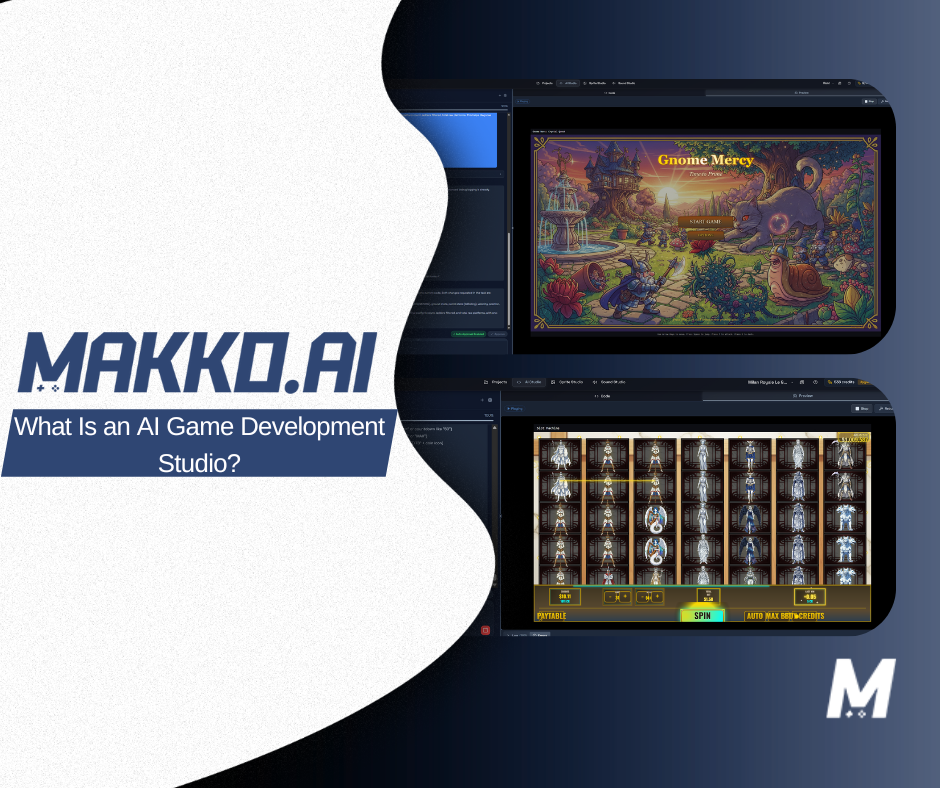
An AI game development studio is a software environment where AI serves as an active participant in building a game, not just a code generator you paste from. The distinction matters because it changes what is possible for the creator. Before going further, it is worth clearing up 5 common assumptions about AI game dev studios that shape how most people approach this category for the first time.
In a traditional engine like Unity or Godot, you write the code, wire the systems, and manage every dependency yourself. In an AI game development studio, you describe what the game should do using natural language, and the AI handles the assembly. The technical work shifts from implementation to intent.
That shift is what separates an AI studio from a wrapper around a language model. A language model answers questions. An AI studio builds things. It tracks state, reasons about what has already been created, and makes decisions that affect multiple systems at once.
Makko is built on this model. Creators start in Art Studio, where they generate concept art, build characters, create backgrounds and objects, and produce animations. Everything is organized through Collections that keep every asset in a consistent art style. When the art is ready, Code Studio turns it into a playable game in the browser. No drawing skills. No coding skills. No prior game development experience required. For a complete walkthrough of this process, see the guide on how to make a 2D game with AI.
What an AI Game Development Studio Actually Does
Three capabilities separate a real AI game development studio from a simple prompt-to-game tool. The first is state awareness: the AI tracks what has already been built so new changes do not break existing mechanics. The second is system orchestration. When you add a level-up system, the AI understands how that affects enemies, UI, and player stats simultaneously, not in isolation. The third is an integrated asset pipeline, where art generation, animation, and game logic live in the same workspace with no external file management required.
This combination is what gives an AI studio durable results. The reasoning layer maintains game state across every iteration, which prevents the state drift that causes most AI-built games to break under real gameplay conditions. Each change builds correctly on what came before.
| Capability | What It Means in Practice |
|---|---|
| State Awareness | The AI tracks what has already been built so new changes do not break existing mechanics. |
| System Orchestration | When you add a level-up system, the AI understands how that affects enemies, UI, and player stats simultaneously, not in isolation. |
| Integrated Asset Pipeline | Art generation, animation, and game logic live in the same workspace. No external file management required. |
Natural Language Game Development and the Implementation-Intent Gap
Most creators know what they want to build. The gap is between that intent and what they can actually execute using traditional tools. Writing code is one barrier. Creating game art is another. Most people run into both at the same time, and that combination is what stops most game ideas from becoming real games.
Natural language game development closes this gap by translating what you describe directly into working art and game systems. You define the behavior. The AI builds the systems behind it. The art pipeline and the code pipeline run in the same environment, so the characters you create in Art Studio are the same ones that appear in your playable game in Code Studio.
This is distinct from what no-code platforms offer. No-code tools let you configure from a fixed menu. If the feature is not listed, it cannot be built. An AI game development studio generates custom logic from your description. You are not picking from templates; you are defining behavior, and the AI builds the systems behind it.
How It Differs From No-Code Tools
No-code platforms let you configure from a fixed menu. If the feature is not listed, it cannot be built. An AI game development studio generates custom logic from your description. You are not picking from templates; you are defining behavior, and the AI builds the systems behind it.
Makko's Code Studio works this way. You describe what you want the game to do in plain English. The agentic AI builds it using the characters and art you already created in Art Studio. You play it in the browser. No configuration menus. No template limits. No preset genre constraints.
When to Use an AI Game Development Studio
An AI studio is the right tool when you are validating an idea, prototyping a core gameplay loop, or building without a dedicated engineering team. It is not a replacement for Unity on a production-scale game. It is a replacement for the weeks you would spend before you know whether the idea is worth building at all.
Many creators use Makko to prototype and validate ideas before moving to Unity or Godot for full production. The decision is not either-or; it is about matching the right tool to the right stage of a project.
| Choose an AI game development studio if... | Choose a traditional engine if... |
|---|---|
| You want to move from idea to playable without writing code or creating art manually | You need deep engine-level customization or multiplayer infrastructure |
| You are iterating on design, not architecture | You are shipping a long-lifecycle, production-scale game |
| You are solo or in a small team without dedicated engineers or artists | You have a full engineering team and a defined tech stack |
For a detailed side-by-side breakdown, see Makko vs Unity and Makko vs Godot.
Where Game Art Fits Into the Studio Model
Most tools that describe themselves as AI game development studios skip past the art entirely. They assume you already have characters, backgrounds, and animations, and they focus on helping you write the code that uses them. That assumption excludes the majority of creators who do not have existing assets.
Makko starts earlier in the process. Art Studio is where you create concept art, build characters with specific gear and details, generate backgrounds and objects, and produce animations. Collections organize everything and keep your art consistent across the entire game. Every character, background, and object inherits the same visual style. By the time you open Code Studio, you already have a complete library of matching game art. The game you build looks like one cohesive world, not a collection of unrelated assets.
This is the end-to-end pipeline that no single competitor currently offers: concept art through animation through a playable game, from one platform, all driven by plain-language descriptions. It is what the AI game development studio category should be, and what most tools in that category are not yet.
Frequently Asked Questions
How does an AI game development studio differ from a no-code game maker?
A no-code game maker lets you configure from a fixed menu of features. If the feature is not listed, it cannot be built. An AI game development studio generates custom logic from a plain-language description. You define the behavior you want and the AI builds the systems behind it, with no template limits or preset genre constraints.
When should I use an AI game development studio instead of Unity or Godot?
Use an AI game development studio when you are validating an idea, prototyping a core gameplay loop, or building without a dedicated engineering team. It is not a replacement for Unity or Godot on a production-scale game. It is a replacement for the weeks you would spend before you know whether the idea is worth building at all. Many creators use Makko to prototype and validate before moving to a traditional engine for full production.
Does Makko include game art generation or do I need to bring my own assets?
Makko includes a full art pipeline through Art Studio. You create concept art, build characters, generate backgrounds and objects, and produce animations, all in the same platform. Collections keep every asset visually consistent across the entire game. By the time you open Code Studio to build a playable game, you already have a complete library of matching game art.
What is the end-to-end pipeline in an AI 2D game studio?
In Makko, the pipeline runs from concept art through character creation, backgrounds, objects, and animations in Art Studio, then into Code Studio where you describe your game in plain English and the AI builds it using your own art. The entire process runs in one platform from a blank page to a playable, shareable game.
For detailed walkthroughs and live feature demos, visit the Makko YouTube channel.