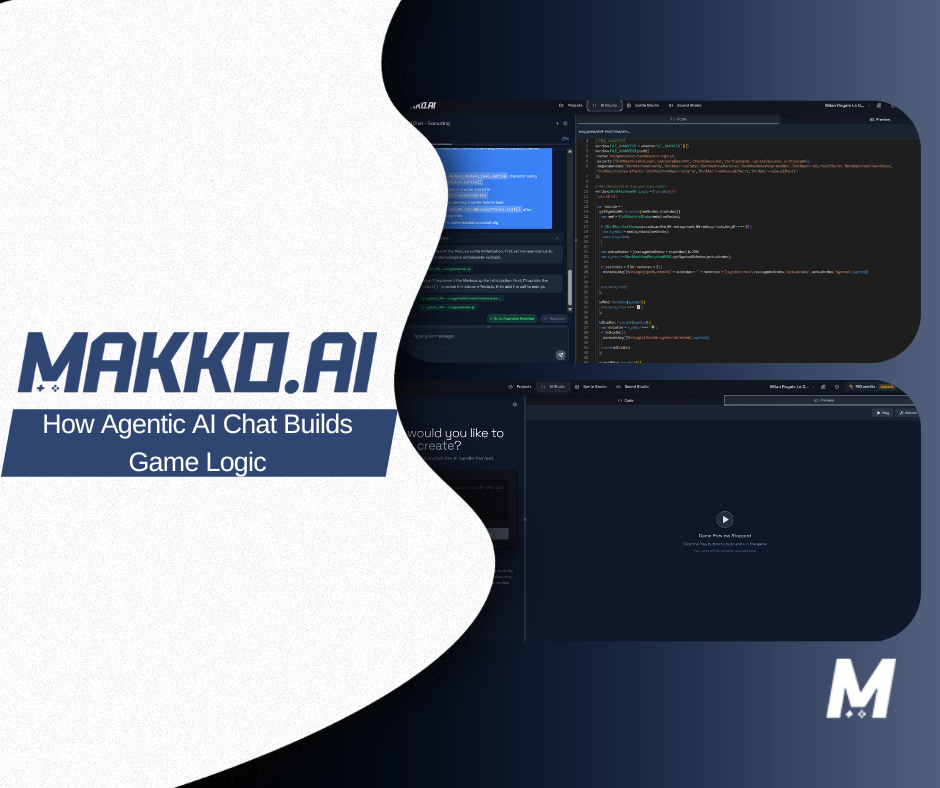
How Agentic AI Chat Builds Game Logic
Explains how agentic AI chat maintains and updates game logic across iterations instead of generating isolated outputs.

Game logic is the set of rules that makes a game work. It determines what happens when the player jumps, what triggers an enemy to attack, when a level ends, how a score updates, and what conditions produce a win or a loss. In a traditional engine, game logic lives in code — scripts written in C#, GDScript, or similar languages that specify every rule, every condition, and every consequence in precise syntax. Changing game logic means changing code. Understanding game logic means reading code.
Agentic AI Chat replaces that model with a conversational one. Instead of writing scripts, creators describe what they want their game to do — and the AI interprets that intent, plans the implementation, and applies it directly to the project. "Spawn five enemies every ten seconds." "End the game when player health reaches zero." "Increase movement speed after each level completed." These are game logic statements expressed in plain language, and Agentic AI Chat turns them into working systems.
This article explains exactly how that process works — what happens between a creator submitting a request and the game reflecting that change, how the system maintains consistency across a project as logic evolves, and why this approach changes what game development looks like for creators who aren't engineers. For definitions of terms used throughout, see the Makko AI Game Development Glossary. If you want to try building game logic through conversation, start building at Makko now.
What Makes Agentic AI Chat Different From a Prompt Tool
The word "chat" is familiar — most people have used some form of AI chat interface. But Agentic AI Chat in a game development context is meaningfully different from a general-purpose prompt-response tool, and understanding that difference is essential to understanding how it builds game logic effectively.
A general-purpose AI chat tool responds to each prompt independently. It doesn't have an ongoing understanding of your project, doesn't know what systems already exist, and can't apply changes directly to a live game. If you ask it to "add an enemy spawn system," it might generate a code snippet — but that snippet exists in isolation. Integrating it into your project, making sure it doesn't conflict with existing systems, and wiring it to the relevant game state variables is still your responsibility.
Agentic AI operates differently. It maintains state awareness — a live understanding of the current project that persists across every request. When you ask it to add an enemy spawn system, it doesn't generate an isolated snippet. It identifies what already exists in the project, determines how the spawn system needs to relate to existing mechanics, plans the implementation in the correct dependency order, and applies it as a coherent addition to the current project state.
The distinction is between a tool that responds to prompts and a system that reasons toward goals. A prompt tool answers questions. An agentic system understands objectives, plans the steps required to achieve them, and carries those steps out across multiple actions while maintaining consistency with everything that came before. This is what makes agentic game development viable as a primary workflow rather than a supplementary shortcut.
How a Request Becomes Game Logic: The Full Process
When a creator submits a request to Agentic AI Chat, several things happen in sequence before the game reflects the change. Understanding this process clarifies both what the system can do reliably and where its boundaries are.
Step one: intent interpretation. The system reads the request and determines what the creator is trying to accomplish at the level of game design — not implementation. "Spawn five enemies every ten seconds" is understood as a desire for a recurring challenge that increases enemy presence over time, not as a literal instruction to create a timer node with a specific interval value. This distinction matters because the implementation details that serve that intent may vary depending on what already exists in the project.
Step two: context evaluation. The system checks the current project state. Does an enemy type already exist? Is there a spawn system in place that this request is extending, or does one need to be created from scratch? What scene is this logic intended to apply to — the current one, all scenes, or a specific subset? State awareness at this stage is what separates a coherent implementation from an isolated one. The system isn't generating logic in a vacuum — it's generating logic that fits into the specific project it has been building and maintaining.
Step three: planning. Agentic planning identifies what needs to be created, what needs to be modified, and what order those changes need to happen in. A spawn system depends on an enemy type existing. The enemy type's behavior depends on detection and movement logic being in place. The spawn timer depends on the scene having a game loop that it can hook into. Task decomposition breaks the request into its constituent steps and sequences them so that each step has what it needs from the steps before it.
Step four: implementation. The planned changes are applied to the project — creating or modifying events, triggers, objects, behaviors, win conditions, or progression logic as required. Because the implementation follows from the planning phase, each change is coherent with the project's existing state rather than being an addition that needs to be manually integrated.
Step five: summary and handoff. The system summarizes what was changed — which systems were created, which were modified, and what the result should look like in the game preview. The creator can test the change, evaluate whether it matches their intent, and submit a follow-up request if it needs refinement. This is where the iterative nature of the workflow becomes most visible: each request is a step in an ongoing conversation, not a discrete transaction.
What Agentic AI Chat Can Build: A Reference Guide
The range of game logic that Agentic AI Chat can implement spans the full scope of what most indie games require. The table below maps the major categories of game logic, the kinds of plain-language requests that address each, and what the system produces.
| Logic Category | Example Request | What Gets Built |
|---|---|---|
| Enemy behavior | "Spawn five enemies every ten seconds, increasing by one each wave" | Spawn system with wave counter, interval timer, and scaling logic wired to current game state |
| Win and loss conditions | "End the game when player health reaches zero, show a retry screen" | Loss condition trigger connected to health state variable, scene transition to retry UI |
| Progression systems | "Increase player movement speed by ten percent after each level completed" | Progression hook on level completion event, stat modifier applied to movement system |
| Economy and inventory | "Add a shop where players spend coins to buy health upgrades" | Shop system with currency tracking, inventory state, purchase validation, and UI display connected consistently across scenes |
| Triggers and events | "Spawn a boss enemy when the player enters the final room" | Zone trigger wired to boss spawn logic with one-time activation and correct scene placement |
| Dialogue and narrative | "Show different dialogue if the player already spoke to this NPC before" | Dialogue system with interaction flag tracking, conditional branch based on prior conversation state |
| Difficulty scaling | "Make enemies faster and more aggressive the longer the player survives" | Difficulty curve system tied to session timer, modifying enemy speed and detection radius over time |
| Save and persistence | "Save the player's score and unlocked levels between sessions" | Persistence layer reading and writing specified state variables, triggered on session end and start |
| UI and HUD | "Show the player's current health and score at the top of the screen" | HUD elements bound to health and score state variables, updating in real time as values change |
| Cooldowns and timers | "The player can only use the dash ability once every two seconds" | Cooldown system on the dash action with timer, input blocking during cooldown, and optional UI indicator |
The Role of State Awareness in Consistent Game Logic
The most technically significant capability of Agentic AI Chat — and the one that most distinguishes it from simpler AI code generation tools — is its ability to maintain consistency across a project as logic evolves. This is state awareness in its most practical form.
Consider what happens in a manually scripted project when a creator decides to change how health works — adding regeneration, for example. In a traditional engine, health is typically a variable stored in one script and read by many others: the UI that displays the health bar, the save system that records it, the death condition that monitors it, and potentially the enemy AI that responds to it. Changing how health works means tracing every system that touches the health variable and updating each one correctly. Miss one and the project has a bug. The more complex the project, the more systems to trace, and the harder it becomes to be confident that every relevant piece has been updated.
In an Agentic AI Chat workflow, state awareness handles this automatically. When a creator asks to add health regeneration, the system knows which systems currently reference the health variable, determines which ones need to be updated to accommodate the new behavior, and applies those updates as part of the same operation. The creator makes one request. The system produces a coherent result across all affected systems. The risk of State Drift — the inconsistencies that accumulate in manually managed codebases when dependencies aren't tracked carefully — is managed by the system rather than by the creator's vigilance.
This is also what makes system orchestration meaningful as a concept rather than just a marketing term. Orchestration isn't about generating individual system components — it's about maintaining the relationships between those components as each one evolves. Agentic AI Chat does this continuously, as a built-in property of how it processes requests, rather than as a separate maintenance task the creator has to manage.
Iteration: How Conversation Shapes Logic Over Time
One of the most practically important aspects of Agentic AI Chat is that it's designed for iteration rather than single-shot generation. A creator doesn't need to specify every detail of a system in their first request. They can start with a rough description, evaluate what gets built, and refine through follow-up requests until the result matches their intent precisely.
This mirrors how good design actually works. A designer doesn't usually know exactly how a mechanic should behave until they've seen a version of it in action. The first implementation reveals what works and what doesn't. The second pass refines based on what the first pass showed. The third pass addresses the edge cases the second pass exposed. The conversation is the design process — and Agentic AI Chat is built to support that process rather than requiring the creator to have the full specification complete before anything gets built.
In practice, this looks like conversational game design: a creator submits a request, receives an implementation, plays the result, identifies what to adjust, and submits a follow-up. "The enemies are spawning too fast — slow the interval to fifteen seconds." "The health bar isn't updating when the player takes damage from the second enemy type." "The boss should only spawn once — right now it's respawning every time I re-enter the room." Each follow-up request is processed in the context of the current project state, so the system understands exactly what the creator is referring to and what change needs to happen to address it.
This iterative workflow is what makes AI game iteration genuinely fast rather than just nominally faster than manual scripting. The feedback loop between intent and implementation stays tight throughout development, and the creator spends their time evaluating and directing rather than implementing and debugging.
Prompt-driven debugging is the most direct expression of this. When something in the game isn't behaving correctly, the creator describes the unexpected behavior in plain language — "the score counter isn't updating when the player collects a gold coin" — and the system identifies the cause and applies a targeted fix. The debugging process becomes part of the same conversational workflow as the building process, rather than a separate technical activity that requires switching tools and contexts.
Reasoning Mode and Task Complexity
Not every game logic request requires the same depth of reasoning before implementation. Adding a new wave of enemies to an existing spawn system is a different category of task from restructuring the progression system that four other mechanics depend on. Agentic AI Chat in Makko accommodates this through selectable reasoning modes — Plan Mode and Fast Mode — that creators switch between freely depending on what the current task requires.
Plan Mode is the right choice when a request is structurally significant — when it touches multiple interdependent systems, when there are implicit decisions that need to be surfaced before implementation begins, or when the scope of the change isn't yet fully defined. In Plan Mode, the chat system asks clarifying questions before building anything. This dialogue phase is where ambiguity gets resolved, where the full shape of the implementation is mapped, and where the creator can catch a structural misunderstanding before it's baked into an implementation that needs to be unwound.
Fast Mode is the right choice when a request is already well-scoped and self-contained — parameter tweaks, visual adjustments, isolated bug fixes, rapid experimentation. In Fast Mode, the system skips the clarifying question phase and applies the change immediately. For the tight iteration loops that vibe coding and active playtesting require, Fast Mode keeps the feedback cycle fast enough that the creator stays in the design space rather than waiting for a reasoning process that isn't adding value to a well-scoped request.
The ability to switch freely between these modes at any point in the project is one of the practical advantages of Agentic AI Chat as a workflow tool. Complex structural work gets the reasoning depth it requires. Everything else gets out of the creator's way.
Who Benefits From Building Game Logic Through Chat
The shift from code-based game logic to conversation-based game logic changes who can build games and what the experience of building them looks like. The benefits aren't uniform across all creator types — they're largest for the creators who were most constrained by the requirement to write and maintain code.
First-time creators benefit most directly. First game development in a traditional engine requires learning a scripting language before any game logic can be implemented. That prerequisite delays creative work for weeks or months while the creator builds technical fluency. Agentic AI Chat removes that prerequisite. A first-time creator can describe game logic in the same language they use to think about it, and receive a working implementation without needing to understand what the implementation looks like underneath.
Designers and artists from adjacent fields gain access to game logic implementation that was previously inaccessible without an engineering background. A UX designer who understands interaction deeply can describe a mechanic the same way they'd write a user story. A writer who has a branching narrative structure in mind can describe the conditions and consequences without knowing how state variables work. Game development without coding means the barrier to expressing a game idea in a working form is no longer programming knowledge — it's the clarity of the idea itself.
Solo developers benefit from the coordination overhead that Agentic AI Chat absorbs. In solo game development, a single creator is responsible for every system in the project simultaneously — not just building each one, but maintaining the relationships between them as the project evolves. State awareness in Agentic AI Chat takes that maintenance responsibility off the creator's plate, freeing their attention for the design decisions that determine whether the game is actually good.
Experienced developers working under time pressure benefit from the speed of the workflow. A developer who can build game logic through conversation rather than by writing and integrating scripts can prototype mechanics faster, test more ideas within a given time budget, and make changes with less fear of cascading regressions. For game jam development in particular — where the entire cycle from concept to finished game happens in 24 to 72 hours — Agentic AI Chat's speed advantage is decisive.
How Makko's Agentic AI Chat Works Alongside the Full Studio
Agentic AI Chat in Makko doesn't operate in isolation — it's one component of a complete AI game development studio where each part of the workflow is connected.
The AI Studio is where game logic, systems, and scene structure live. Agentic AI Chat operates within the AI Studio, applying changes to the project's logic layer through conversation. When the chat system assembles a spawn system or wires a dialogue branch, that work becomes part of the project in the same way that manually coded logic would — it's part of the project state that subsequent requests are aware of and consistent with.
The Sprite Studio handles the visual side — characters, animations, props, and environments. Frame-by-frame AI animation generates animation states from descriptions, and those states connect to the logic layer automatically — an attack animation triggers in response to the attack mechanic, an idle animation plays when no input is detected, without the creator needing to wire these connections manually. The visual and logic layers are coordinated by the same state awareness system that keeps logic consistent across scenes.
Publishing is the final step, and it integrates with the same workflow. Once a build is ready, instant game publishing generates a shareable game link in a single action — no build pipeline, no export configuration, no separate hosting setup. The game moves from the chat-to-playable workflow directly to a browser-native game that anyone can play from a link, immediately.
What Agentic AI Chat Doesn't Do
Being clear about the boundaries of Agentic AI Chat matters as much as describing its capabilities — because overselling what any tool can do leads to misaligned expectations that undermine trust in what it can actually deliver.
Agentic AI Chat implements game logic. It does not design games. The creative decisions that determine whether a game is worth playing — what the core loop should reward, how challenge should scale, whether the moment-to-moment interaction creates the experience the creator is aiming for — remain entirely in the creator's domain. The system responds to intent; it doesn't generate intent. A creator who describes a game mechanic will receive an implementation of that mechanic. A creator who doesn't yet know what mechanic they want will need to develop that clarity themselves.
Agentic AI Chat also doesn't replace playtesting. It can implement logic faster and maintain consistency more reliably than manual scripting — but the question of whether the implemented logic produces an experience that players find engaging is answered by playing the game, not by the system that built it. What Agentic AI Chat provides is the ability to reach testable builds faster and iterate on them with less friction, which means more playtesting cycles are available within the same time budget. The testing itself still belongs to the creator.
And Agentic AI Chat doesn't work well on requests that are genuinely underspecified. "Make the game more fun" isn't a game logic request — it's a design direction. The system needs something concrete enough to implement. The quality of what gets built is proportional to the clarity of what gets asked. Developing the skill to describe game behavior precisely — in terms of conditions, consequences, and relationships between systems — is what separates creators who get the most out of Agentic AI Chat from those who find it frustrating.
The Interface That Makes Intent Executable
Agentic AI Chat is, at its core, the interface that closes the Implementation-Intent Gap. The gap between describing what a game should do and having a working implementation of it has historically been filled by code — and code requires a level of technical expertise that most creators who have game ideas don't have and didn't sign up to acquire.
Conversation fills that gap instead. Not because conversation is simpler than code — it's because the creator is already fluent in it. The knowledge required to use Agentic AI Chat effectively is game design knowledge: understanding what makes mechanics work, how systems interact, what conditions produce which consequences. That's the knowledge creators already have. The implementation knowledge that code requires is what they don't — and what the system now handles for them.
In the Prototype Economy, where the ability to move from idea to testable game quickly is a meaningful competitive advantage, this shift in what the creator is responsible for changes what kinds of games get made and who gets to make them. If you have a game worth building, start building at Makko and see what it looks like when implementation gets out of the way of intent.