Prompt-Based Game Creation: How Text Becomes Gameplay
Explains how prompt-based game creation functions behind the scenes and why structure matters more than wording.

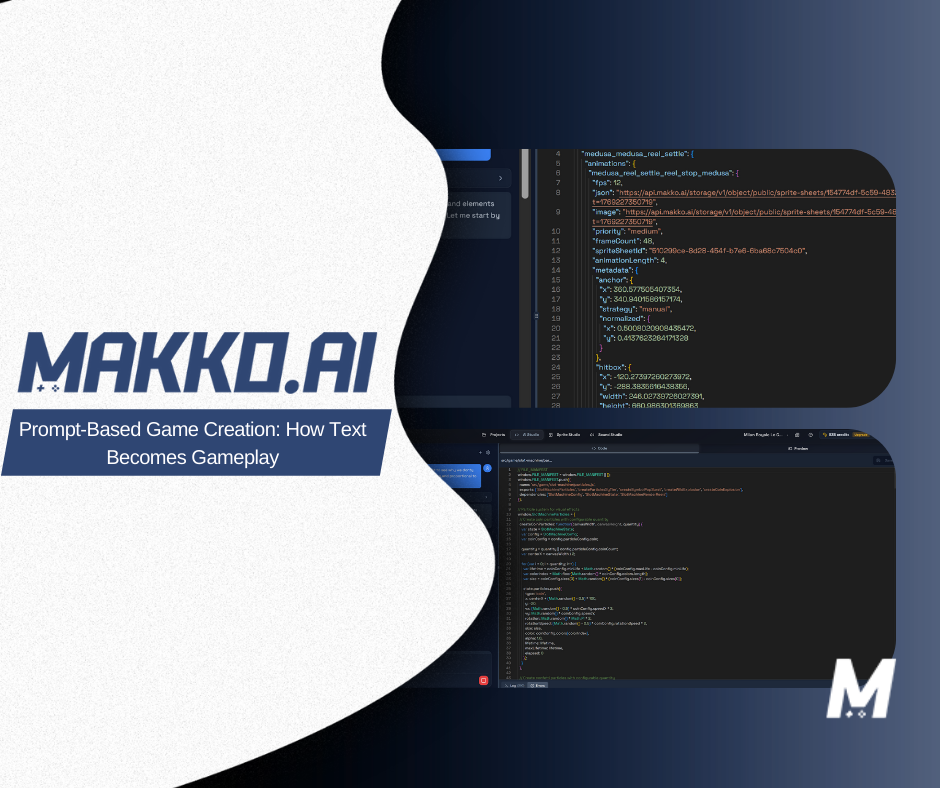
Prompt-based game creation is an approach to game development where a creator uses written prompts to describe what a game should do, and an AI system generates a playable experience from those descriptions. Instead of manually designing scenes, characters, and rules, the creator writes instructions such as “Create a futuristic city level with flying cars” or “Add a boss battle with a dragon.”
In an AI game development studio , the system interprets these prompts, generates game-ready assets, and assembles them into a functioning game. Creators then refine the result by adding or modifying prompts, enabling rapid iteration without writing traditional code.
This article explains what prompt-based game creation means in practice, how the workflow works step by step, and why it is fundamentally different from implementation-first development. For definitions of terms used below, reference the Makko AI Game Development Glossary .
New to Makko? See how it works.
What Prompt-Based Game Creation Means
In a prompt-based workflow, prompts replace many manual development steps.
Rather than scripting behaviors or wiring systems by hand, the creator expresses intent in plain language. The AI system translates that intent into structured game logic, assets, and interactions.
This workflow is closely related to natural language game development and is powered by multi-step planning and coordination rather than isolated one-shot generation.
How Prompt-Based Game Creation Works
1. Describe Your Game Idea
The process begins with a prompt that outlines the core idea of the game. This might include theme, objective, or the primary mechanic.
Examples include:
- A side-scrolling platformer set in a neon city
- A top-down dungeon crawler with elemental enemies
At this stage, the creator is defining the game loop and overall direction, not technical implementation details.
2. AI Interprets the Prompt
The AI system analyzes the prompt to identify what must exist for the game to be playable. This typically includes:
- Scene structure
- Objects and characters
- Behaviors and interactions
- Relationships between systems
This interpretation step enables the system to plan how components should work together instead of generating disconnected outputs.
3. Content and Asset Generation
Once the prompt is interpreted, the AI generates the content required to support gameplay.
This can include:
- Characters via an AI character creator
- Movement and actions through animation generation
- Environments using AI background generation
- Optimized visuals such as sprite sheets
In a true AI-native workflow, these are produced as game-ready assets that are immediately usable in the project.
4. Logic Assembly and Coordination
After assets exist, the AI assembles the rules and interactions that make the game playable.
This includes setting up:
- Events and triggers
- Game state changes and progression
- Scoring, collisions, and win/loss conditions
The key difference is that the AI coordinates systems as a connected whole, rather than generating isolated rules that require manual integration.
5. Iterate Using Additional Prompts
Iteration is central to prompt-based game creation. Creators playtest the game, identify what needs adjustment, and issue follow-up prompts such as:
- Increase enemy speed over time
- Reduce the difficulty of the first level
- Add a new enemy type after level three
Because the system maintains awareness of game state and system relationships, changes can be applied without rebuilding from scratch. This enables fast AI-assisted iteration .
Key Characteristics of Prompt-Based Game Creation
Text-Driven Workflow
Inputs are written as prompts. Creators focus on describing outcomes rather than implementation details, making the workflow accessible to non-programmers.
Automated Asset Creation
Characters, environments, animations, and other assets are generated to match the prompt, reducing manual production work and setup time.
Connected Systems
Prompt-based systems manage dependencies between logic and assets. Actions trigger the correct behaviors, and changes propagate across systems without manual wiring.
Rapid Prototyping
By adjusting prompts instead of rewriting code, creators can generate and refine multiple versions of a game quickly. This makes prompt-based creation ideal for experimentation and concept exploration.
Who Benefits From Prompt-Based Game Creation
Prompt-based game creation is useful for:
- Beginners with no coding background
- Designers prototyping mechanics
- Artists exploring interactive ideas
- Indie developers accelerating development
- Educators teaching game design concepts
The shared benefit is the ability to turn ideas into playable prototypes with minimal technical friction.
How Makko Supports Prompt-Based Game Creation
Makko is an AI game development studio designed specifically for prompt-based workflows.
Makko combines:
- Agentic AI Chat for multi-step reasoning
- An AI Studio for orchestrating logic and systems
- A Sprite Studio for characters, animations, and sprite sheets
- Structured outputs optimized for gameplay and iteration
This allows creators to build games by describing what they want and refining the result through conversation.
Limitations to Understand
Prompt-based workflows reduce implementation overhead, but they do not eliminate constraints. They work best for rapid prototyping, logic-driven mechanics, and early-stage development.
Projects that require deep engine-level customization, specialized performance optimization, or complex multiplayer infrastructure may still move into a traditional engine later.
Final Takeaway
Prompt-based game creation allows creators to build playable games by describing ideas in natural language rather than manually implementing every system.
By combining AI interpretation, automated asset generation, and coordinated game logic, prompt-based workflows reduce development friction and enable rapid experimentation.
As AI game development studios evolve, prompt-based game creation is becoming a practical way to explore, prototype, and build games through intent-driven iteration.
Related Reading
- AI Game Generator From Text
- How Agentic AI Chat Builds Game Logic
- AI Character Creator vs Sprite Sheets: What’s Actually Happening
- How to Add Animated Characters to a Game Using Makko
Build Games Through Prompts
If you want to experiment with prompt-based creation and build playable games through intent-driven workflows, Makko provides an AI-native environment designed for planning, system assembly, and fast iteration.
Build with prompts. Start Building Now.
For tutorials and walkthroughs, visit the Makko YouTube channel .