
The Setup Friction Benchmark: Makko vs. Traditional Engines

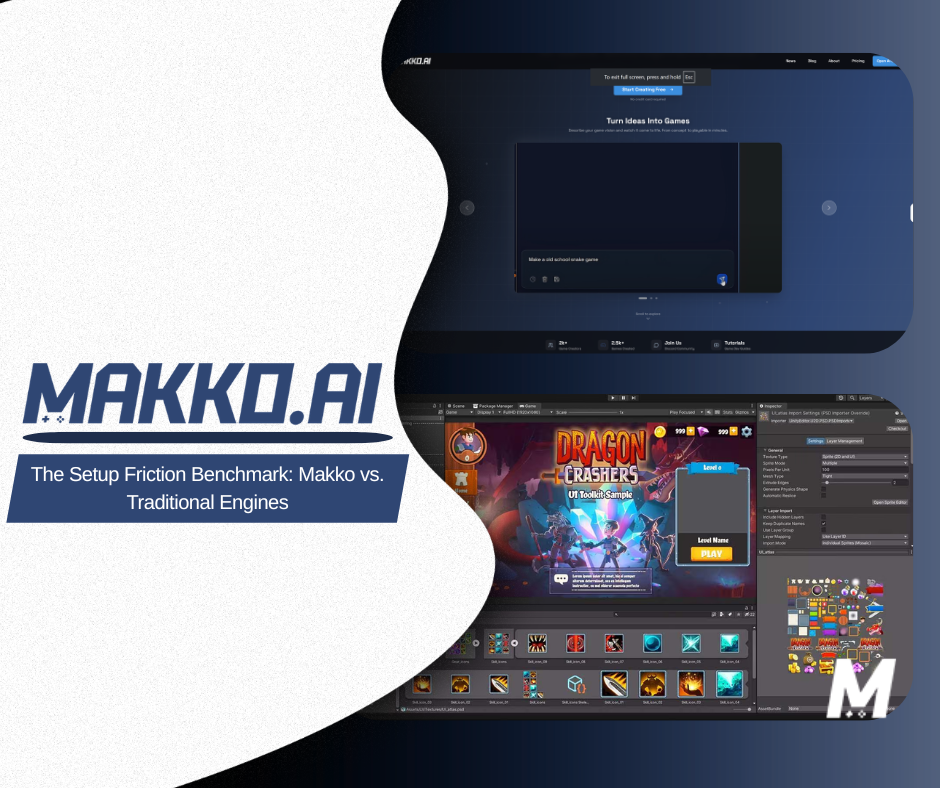
In 2026, the gap between a game that ships and one that stalls has almost nothing to do with creative talent — it comes down to setup friction. Traditional engines like Unity and Godot force creators through the Boilerplate Wall: manual SDK installs, hand-wired collisions, and instructional scripting that consumes the first several days of a project before a single game loop becomes playable. An AI game development studio removes this entirely through system orchestration — automating the foundational wiring so creators move straight into building.
The result is a chat-to-playable workflow that dramatically compresses Time-to-Playable compared to manual initialization. If you're ready to skip the wall entirely, start building at Makko now. This article breaks down exactly where that friction comes from at every stage of the pipeline — and how intent-driven game development closes the Implementation-Intent Gap for good.
What Is Setup Friction — and Why Does It Kill Projects?
Setup friction is the accumulated cost of everything a creator has to do before they can answer the only question that actually matters: is this fun? In a traditional engine workflow, that cost is substantial. Before a single character moves on screen, a creator working in Unity or Godot has typically already spent time installing and configuring the engine, creating a project structure, importing assets, configuring the physics system, writing or copying a basic character controller, wiring input mappings, setting up a camera rig, configuring collision layers, and writing enough state-machine logic to make the character respond to input at all.
None of that work is creative. All of it is load-bearing. Skip any step and the project doesn't run. This is the Boilerplate Wall in practice — not a single obstacle but a sequence of technical prerequisites that stack before any actual game design begins.
The industry has known about this problem for years. It's the reason game engine marketplaces exist: creators buying pre-built character controllers, pre-wired UI systems, and starter kits just to get past the setup phase faster. It's the reason "starter templates" are one of the most downloaded asset types on every major engine store. The workarounds are everywhere because the underlying problem is so consistently painful.
For solo game development and first-time game developers, the wall hits hardest. A studio distributes setup work across multiple specialists — an engineer handles the build pipeline while a designer blocks out levels. A solo creator has to do both, sequentially, before they can test a single interaction. The cognitive load of switching between technical implementation and creative intent, repeatedly, is where most early-stage projects lose momentum and quietly get abandoned.
The State Drift Problem: Why Manual Pipelines Break Under Iteration
Setup friction is the first problem. The second — and in many ways the more damaging one — is what happens when you try to change anything after setup is done.
In engines using imperative code like C# or GDScript, game state is managed manually. Every variable that tracks the player's health, score, inventory, progress, or position exists somewhere in the codebase as a reference that other systems depend on. When you change how one of those variables works — say, you decide health should regenerate over time instead of being a static value — you don't just update one file. You update every system that reads, writes, or reacts to health. That means the combat system, the UI, the save system, the death condition, and any enemy AI that responds to the player's health state all need to be revisited.
This is State Drift: the inconsistency that builds when system dependencies are modified without full orchestration across the project. It's not a bug you can see immediately. It's a slow accumulation of misalignments that surfaces later, often in ways that are hard to trace back to their origin. A score that doesn't update correctly. A save file that restores the wrong health value. A death condition that triggers when it shouldn't because an edge case was introduced three refactors ago.
State drift is a natural consequence of manual pipelines because the responsibility for maintaining consistency falls entirely on the creator. Every change is a potential point of failure, and the more complex the project becomes, the more cognitive load is required just to keep the existing systems from breaking — let alone improve them.
For game development without coding to be viable, this problem has to be solved at the architectural level, not patched with workarounds. That's what state awareness in an AI-native workflow actually means: the system holds the current state of the entire project in context and ensures that changes made in one area propagate correctly to dependent systems — automatically, without the creator having to track it manually.
Intent-Driven Orchestration: How the AI-Native Pipeline Works
The shift to intent-driven game development doesn't just speed up the existing workflow — it replaces the underlying model entirely. Instead of a creator specifying every implementation detail and the engine executing those instructions, the creator describes the desired outcome and the AI handles implementation.
In practice this looks like conversational game design: a creator opens a project and describes what they want — "a side-scrolling platformer with procedural obstacles, a double-jump mechanic, and a score that increases the longer you survive" — and the system interprets that intent, decomposes it into implementable components, and assembles a working build.
The technical engine behind this is agentic planning. Rather than responding to a single prompt with a single output, the AI treats the creator's description as a goal and performs task decomposition — breaking the goal into its constituent systems, identifying dependencies between those systems, and determining the correct order of assembly. Physics layers need to exist before collision can be configured. Collision needs to be configured before movement can be tested. Movement needs to work before a double-jump can be layered on top.
A creator using Plan Mode sees this dependency mapping happen before any code is written — giving them the chance to course-correct at the structural level rather than discovering a foundational mistake three hours into implementation. Once the plan is confirmed, Fast Mode handles the rapid assembly of assets and logic, optimized for low-latency iteration on visual and systemic details.
The result of this architecture is that AI-assisted game prototyping doesn't feel like using a tool — it feels like working with a collaborator who handles the technical groundwork while you make design decisions. The Implementation-Intent Gap closes because the gap itself — the space between what you want and what the code needs to say — is bridged by the AI rather than navigated manually by the creator.
Pipeline Comparison: Traditional Engine vs. AI-Native Workflow
The differences between a manual engine pipeline and an AI-native one aren't just about speed — they're about where creative energy goes at each stage. The table below maps the same core development phases across both approaches, showing what the creator is responsible for at each step and what the system handles automatically.
| Pipeline Stage | Traditional Engine (Unity / Godot) |
AI-Native Workflow (Makko) |
|---|---|---|
| Project initialization | Manual engine install, project config, folder structure setup, SDK linking | Describe the game concept — project structure assembled automatically via system orchestration |
| Asset import | Manually import, slice, and configure sprite sheets; set pivot points; assign physics materials | AI game asset generation produces and imports game-ready assets; anchor points set automatically |
| Character setup | Write character controller from scratch or adapt a template; wire input mappings; configure hitbox | Describe movement and behavior in plain language; agentic planning wires controller, input, and hitbox together |
| Animation system | Build state machine manually; define transitions; align frames to prevent jitter | Frame-by-frame AI animation generates states and transitions; alignment handled by the alignment tool automatically |
| Core game systems | Manually code score, health, save, win/loss conditions; wire each to relevant systems | AI game mechanics generation implements and connects core systems from description; state awareness keeps them consistent |
| Level / environment | Hand-place tiles or build procedural system; configure lighting; test navigation | AI-generated game levels built from theme and gameplay parameters; ready for immediate playtesting |
| Iteration and debugging | Trace code manually; identify which system introduced the regression; refactor and retest | Prompt-driven debugging — describe unexpected behavior, AI diagnoses and applies targeted fix |
| Publishing | Configure export settings; manage platform-specific build requirements; package and upload manually | Instant game publishing generates a shareable game link in one action — no packaging or upload steps |
| Who this suits | Experienced developers with engine-specific knowledge and time to invest in technical setup | Designers, artists, writers, and solo developers who want to focus on creative decisions — not implementation |
The plain-English version of this table: in a traditional engine, the creator is the integration layer. Every system that needs to talk to every other system goes through you — your code, your wiring, your knowledge of how each component expects to receive and send data. In an AI-native workflow, the AI is the integration layer. Your job is to describe what the game should do, evaluate what gets built, and redirect when something isn't right.
The Prototype Economy: Why Iteration Speed Is the Real Moat
There's a reason the game industry in 2026 increasingly talks about iteration velocity as a competitive advantage rather than production quality. The market for indie games and browser-native experiences has matured to the point where discoverability and differentiation are harder to achieve through polish alone. A technically flawless game that took eighteen months to build can be outpaced by a mechanically sharp game that shipped in three weeks, found an audience, and iterated based on real player feedback.
This is the logic of the Prototype Economy: the value of an idea is measured by how fast it can be functionally tested, not how long it took to build. In this environment, the ability to go from concept to playtest in hours rather than days isn't a nice-to-have — it's the mechanism by which a solo creator or small team can compete with studios that have ten times the headcount.
Traditional pipelines are structurally misaligned with this reality. When debugging a single broken mechanic requires tracing through interdependent systems to find which change introduced the regression, each iteration cycle has a meaningful fixed cost in time and attention. That cost compounds: the more complex the project becomes, the longer each debug-and-refactor cycle takes, and the less frequently a creator can run a full playtest. The result is that larger projects naturally slow down the more progress is made — the opposite of what good creative momentum looks like.
Prompt-driven debugging changes this dynamic fundamentally. When resolving a broken mechanic means describing what went wrong in plain language and having the AI identify the cause and apply a targeted fix, the fixed cost per iteration cycle drops sharply. Creators can run playtests more frequently, get to answers faster, and keep the creative momentum that manual pipelines systematically erode.
Combined with AI game iteration — where refining a system is as simple as describing the change you want — the full loop from idea to validated gameplay becomes something a single creator can realistically run multiple times in a day. This is what workflow accelerators actually unlock: not just faster production, but a fundamentally different relationship between creative intent and functional output.
Who This Matters Most For
The efficiency gains of an AI-native pipeline aren't evenly distributed. They're largest for the creators who were most penalized by the manual pipeline in the first place.
Solo developers are the clearest beneficiary. Solo game development has always required a creator to function as designer, developer, artist, and QA simultaneously — switching contexts constantly and absorbing the coordination overhead that studios distribute across specialized roles. AI-native tools don't just speed up individual tasks; they absorb the coordination layer entirely, letting a solo creator operate with the effective output of a small team without the management overhead.
First-time creators are the second major group. First game development has historically meant spending the majority of initial effort learning engine-specific syntax and conventions before any creative work begins. The result is that most first games never get finished — not because the ideas weren't good, but because the distance between idea and implementation was too wide to cross without prior technical experience. Text-to-game workflows collapse this distance. A first-time creator who has never written a line of code can produce a playable prototype by describing what they want — and then iterate on it using the same conversational interface.
Designers and artists from adjacent fields — film, interactive fiction, UX, illustration — represent a third group. These creators often have strong ideas for games and sophisticated visual sensibilities, but have historically been blocked from building by the programming prerequisite. Game development without coding removes that barrier without dumbing down the output. A UI designer who understands interaction can describe a mechanic the same way they'd write a user story — and receive a working implementation they can immediately evaluate and redirect.
Experienced developers working under time pressure are the fourth group — and perhaps the most surprising one. Professional developers who use traditional engines don't stop encountering the Boilerplate Wall; they've just learned to move through it faster. But faster still has a cost, and for developers running game jam projects, building proof-of-concept prototypes, or exploring new mechanics quickly, the time saved by offloading setup and wiring to an AI-native tool is immediately valuable — freeing their technical skill for the parts of the project that actually require it.
From Playable to Published: Closing the Last Mile
Most discussions of Time-to-Playable focus on the front end of development — getting from idea to first working build. But there's a second friction point that catches many projects: the gap between a finished game and a game that's actually accessible to players.
In traditional engine workflows, publishing is its own project. Web deployment requires configuring export settings for the correct build target, managing file sizes, setting up hosting, and often debugging platform-specific issues that only appear after export. For mobile, the process involves developer accounts, signing certificates, and app store submission with its own review timeline. For a solo creator who just finished building their game, this last-mile friction can feel disproportionately heavy relative to the actual work remaining.
Browser-native game publishing sidesteps this entirely. Games built for browser delivery run directly in a web environment without plugins, downloads, or app store approval. The creator's audience can play the game immediately from any device — no installation required. Combined with instant game publishing that generates a shareable game link in a single action, the path from finished build to live audience shrinks from hours to seconds.
This matters beyond convenience. In the Prototype Economy, the ability to share a build with players immediately after completing an iteration cycle means feedback arrives faster, and the next iteration can begin sooner. The publishing step stops being a gate and becomes part of the iteration loop — a build goes live, players respond, the creator adjusts, and a new build goes live. The entire cycle becomes tighter, more responsive, and more creatively productive.
The Shift Is Already Happening
The traditional game development pipeline was designed around a set of constraints that no longer apply: the assumption that building a game requires deep engine-specific expertise, that coordination between systems must be managed manually, and that publishing is a separate technical project from development. Those assumptions made sense when the tools available required them. They don't hold in 2026.
AI-native game development isn't a shortcut through the same pipeline — it's a different pipeline built on different assumptions. The creator's job is not to specify every implementation detail; it's to hold the vision, evaluate what gets built, and direct the AI toward outputs that match the intended experience. The Implementation-Intent Gap closes because the AI occupies the space between creative intent and working code — the space where most projects used to stall.
For solo developers, first-time creators, designers from adjacent fields, and experienced developers under time pressure, the result is the same: more of the available time and energy goes toward creative decisions that determine whether the game is actually good, and less goes toward the technical prerequisites that determined whether it got built at all.
The wall is still there for everyone using a traditional engine. The question is whether you want to climb it every time, or build somewhere it doesn't exist.