What Is Intent-Driven Game Development?
Defines intent-driven game development and explains how focusing on outcomes changes how games are planned and built.

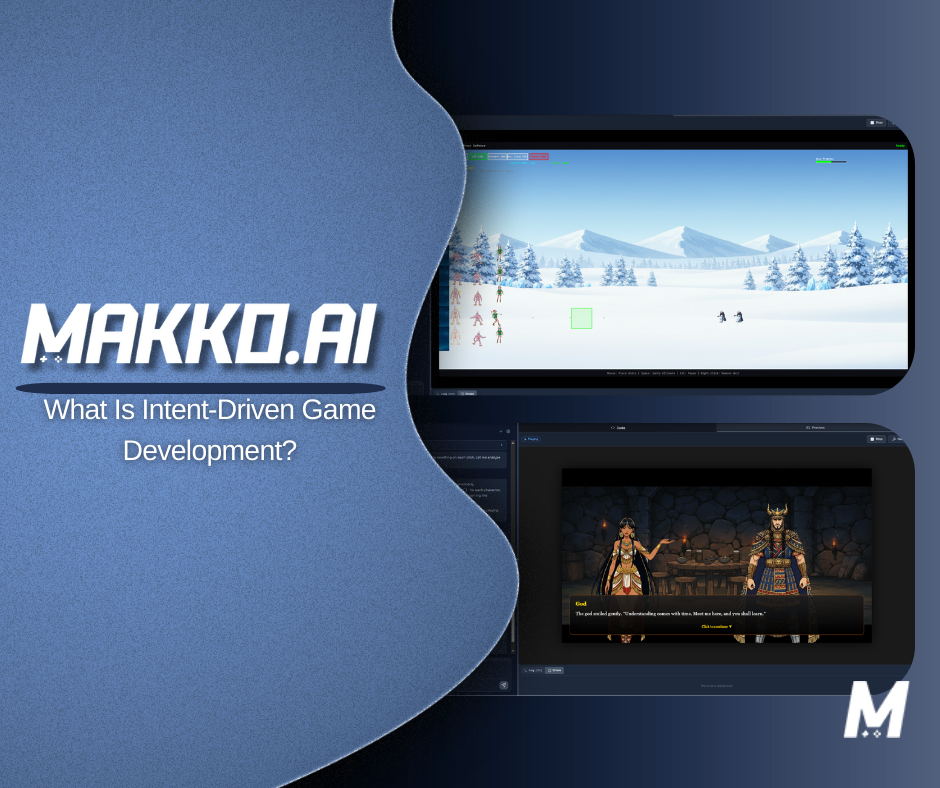
Intent-driven game development is a way of building games where the creator specifies what should happen rather than how to implement it. Instead of writing code for input handling, state updates, or collision detection, the creator describes the intended outcome in plain language.
For example, instructions such as “Add a character, play a walk animation at 12 frames per second, and flip the sprite on the X axis when moving left” express intent rather than technical steps. An AI game development studio interprets these descriptions, plans the required systems, generates the necessary assets and game logic, and executes them automatically.
This article explains how intent-driven game development works, what makes it different from traditional workflows, and why it allows creators to focus on design and iteration instead of technical implementation. For definitions of terms used below, reference the Makko AI Game Development Glossary.
New to Makko? See how it works.
How Intent-Driven Game Development Works
Intent-driven workflows rely on AI to translate high-level goals into structured game systems. The creator communicates intent using natural language game development , describing desired behaviors, rules, and outcomes.
The AI analyzes those instructions, determines which systems are required, and assembles the logic and assets needed to support the outcome.
Rather than responding to single commands in isolation, the system uses agentic AI to plan and coordinate multiple steps while maintaining awareness of the overall project.
Key Characteristics of Intent-Driven Game Development
High-Level Instructions
Creators describe mechanics, scenes, and interactions using outcome-focused language.
Examples include:
- Spawn enemies every ten seconds
- Increase difficulty after each level
- End the game when health reaches zero
These instructions define intent without requiring scripts, manual configuration, or engine-specific syntax.
AI Interpretation and Reasoning
The AI system interprets creator intent using reasoning models that translate descriptions into structured rules and behaviors.
This includes:
- Defining game mechanics
- Managing game state and transitions
- Connecting actions, conditions, and outcomes
This interpretation step is critical for ensuring that changes remain consistent across the game.
Automated Planning and Coordination
Once intent is understood, the system plans how to implement it.
Using agentic planning and AI-orchestrated systems, the AI sequences tasks and coordinates:
- Character behaviors
- Animations
- Events and interactions
- Progression rules
This planning layer allows complex behaviors to emerge from simple descriptions.
Reduced Technical Friction
By handling implementation behind the scenes, intent-driven game development significantly reduces technical overhead.
Creators no longer need to wire systems together manually or manage boilerplate logic. Instead, they iterate by refining descriptions, which enables rapid prototyping and experimentation.
Focus on Creativity and Design
Because technical execution is abstracted away, creators can spend more time on:
- Game feel and pacing
- Narrative structure
- Level design and progression
- Player experience
Intent-driven workflows make it easier to explore ideas and adjust gameplay without rewriting code.
Intent-Driven Game Development vs Traditional Workflows
Traditional game development requires developers to think in terms of implementation details. Every change involves editing scripts, updating systems, and testing for regressions.
Intent-driven game development shifts this responsibility to the AI system. The creator focuses on defining goals, and the system determines how to implement them.
This does not remove the need for design thinking, but it changes how design decisions are expressed.
Who Benefits From Intent-Driven Game Development
Intent-driven game development is useful for:
- Beginners learning game design concepts
- Designers prototyping mechanics
- Artists creating interactive experiences
- Indie developers working with limited resources
- Educators teaching systems thinking
The shared benefit is faster movement from idea to playable experience.
How Makko Supports Intent-Driven Game Development
Makko is an AI game development studio built around intent-driven principles.
Makko combines:
- Agentic AI Chat for multi-step reasoning
- An AI Studio for planning and orchestrating logic
- A Sprite Studio for characters, animations, and sprite sheets
- Structured, game-ready outputs
This allows creators to describe what they want to happen and let the system handle the technical translation.
Final Takeaway
Intent-driven game development is a workflow where creators define goals and outcomes rather than implementation details.
By combining natural language input, AI reasoning, and automated system coordination, intent-driven approaches reduce technical barriers and accelerate iteration.
As AI game development studios evolve, intent-driven game development is becoming a practical way for both beginners and experienced developers to build playable games through clear descriptions of intent.
Related Reading
- What Is Agentic AI in Game Development?
- Prompt-Based Game Creation: How Text Becomes Gameplay
- How Agentic AI Chat Builds Game Logic
- Makko AI Game Development Glossary
Build Games Through Intent
If you want to build games by describing outcomes instead of managing implementation, Makko provides an AI-native environment designed for intent-driven workflows.
Build with intent: Start Building Now.
For tutorials and walkthroughs, visit the Makko YouTube channel .