
7 Free Tileset Resources, and What You Give Up Using Them
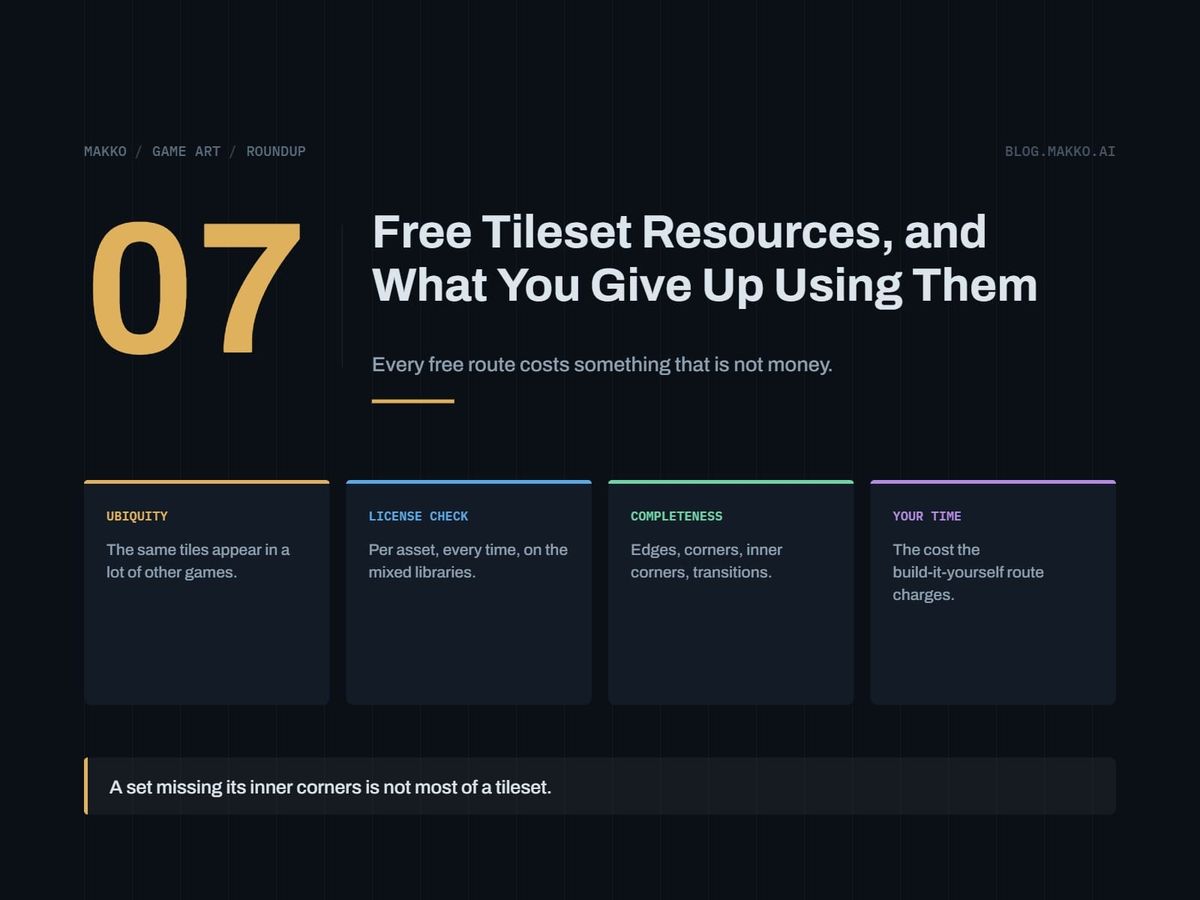
Every free route costs something that is not money. Ubiquity, per-asset licence checking, commercial-use limits, or your own time. Each one is named here.
There are seven realistic ways to get tileset art without paying money for it. All seven work, and none of them are free, because every one charges you in something other than cash, usually invisibly, usually after you have committed.
This list is for a solo developer or a small team's programmer who can ship a game and cannot draw. Each route gets what it is built for, its license catch, and who should pick it. Disclosure: this is Makko's blog, Makko is an AI-powered 2D game art studio, and it is a paid product rather than one of the seven free routes. Prices and plan terms are as of September 2026, read off the vendors' own pages.
One structural fact governs the list. A tileset is a combinatorial system, not a folder of images: every material needs a fill, four edges, four outer corners and four inner corners at minimum, and every pair of materials that can touch needs a transition set. A free set missing its inner corners is not most of a tileset. It is a tileset you cannot finish a level with, and you find out at the first L-shaped ledge. That argument is in when not to use tiles; the anatomy of a working set is in tileset design for developers.
The short version. Prototyping or jamming: take Kenney's CC0 sets and stop reading, since they are free commercially and need no attribution. Shipping something with a visual identity: draw a small set yourself in a free editor, because your time is the only free cost you control. OpenGameArt and itch.io free listings sit in between and charge per-asset license checking forever. AI free tiers restrict what you can do with the output, so read the plan terms first.
How these were picked
- Money cost. Zero for all seven, the only column where they tie.
- Commercial use. Can you sell a game containing this? Free and free-to-ship are different things, and the gap is where most lists go quiet.
- License admin. Terms learned once, or per asset, forever? Per-asset checking is a recurring cost nobody budgets for.
- Consistency. A coherent set, or pieces you reconcile later?
- Completeness. Fill, edges, outer corners, inner corners, transitions. A route that hands you 80 percent of a system has handed you a problem.
1. Kenney's CC0 sets
Kenney publishes large sets of game assets into the public domain under CC0, alongside some paid bundles. CC0 means free to use commercially with no attribution required: no license to read per download, no share-alike clause waiting for you. For license admin this is the best deal on the list, and the only route here where "can I sell this" is a flat yes.
What it costs: ubiquity. Thousands of other games use the same assets, and anyone who plays indie games has seen them. That recognition does not read as theft. It reads as a placeholder nobody replaced, and it caps the identity your store page can carry.
Pick it if you are prototyping, jamming, or shipping something whose identity comes from mechanics. Skip it if the look is part of what you sell.
2. OpenGameArt
OpenGameArt is a community asset library built over many years by many contributors, and the most likely place to find a specific thing nobody sells.
What it costs: licenses are mixed, and each asset has to be checked individually. The terms live on the asset, not on the site, so you cannot read them once and apply them everywhere. Some ask for attribution in a specific form. Some carry conditions that follow the asset into whatever you build.
Pick it if you need one specific thing and will do the license reading. Skip it if you are assembling a whole set from many contributors, since you pay the check cost repeatedly and reconcile styles too.
3. Free listings on itch.io
itch.io is a marketplace where many independent creators sell and give away game assets, tilesets included. A free listing there can be a complete set or a sample of a paid one, so check which you are downloading.
What it costs: licenses vary per listing and must be checked per asset, every time. That includes the second download from a creator whose terms you already read, because terms are set per listing and one creator can use different terms on different pages.
That distinction has teeth. A sample is chosen to look good in a screenshot, and a screenshot never shows an inner corner, so a sample can be a fill and a few edges with the corners held back.
Pick it if you are filling a specific gap and will check terms per download. Skip it if you want one coherent set and are tempted to stitch it from six creators.
4. Sample and demo projects that ship with engines
Every mainstream 2D engine ships demos, and the demos contain tiles. Godot is free and open source under the MIT license, with no royalties, no revenue thresholds and no seat costs. GameMaker has a free tier covering GX Games, desktop, web and mobile exports, and a Professional tier, a one-time purchase, adding the commercial license.
What it costs: license restrictions, specifically that the engine's license and the demo art's license are two different documents. An MIT-licensed engine does not make its bundled demo art MIT, so check the asset's own terms before moving a single tile.
The engine tier matters separately. GameMaker's free tier is a non-commercial license, so a project built on it is non-commercial until you buy Professional, whatever the art's terms say. Godot has no such condition at any level.
Pick it if you are learning how autotiling behaves in your engine, since demo tiles come configured. Skip it as a shipping route unless you have read the asset's license.
5. Generating your own on an AI tool's free tier
Several AI image tools run free tiers you can make tile art on. Scenario's free tier gives 50 free daily credits, no credit card required. Leonardo.Ai's free plan is $0 per month with 150 fast tokens per day, a token bank of 150 and one personal collection. Rosebud AI has a free plan, and a downgraded account gets 20 prompts per week.
What it costs: commercial use, restricted differently by each. Scenario's free plan outputs are for personal and evaluation use only, so nothing made on it can ship. Leonardo's free tier makes your creations public and grants a non-exclusive royalty-free license rather than the full ownership paid subscribers get. Rosebud's commercial rights come only with its 10x Dev or Pro plans, which allow selling games and assets made with it and take no commission on earnings.
Treat these tiers as what the terms say they are: a way to learn whether a tool makes the look you want before paying. Paid plans resolve the restriction. At the time of writing, Scenario's Starter plan is $15 per month with 1,500 monthly credits and every Scenario paid plan includes a full commercial license; Leonardo's Essential plan is $12 per month with 8,500 fast tokens and private creations.
Tiles also have to agree at the pixel level along shared edges, and prompting them one at a time gives images that look related and do not tile. Pick it if you are evaluating. Skip it if you plan to ship the output without first meeting that tool's free-plan terms.
6. Drawing a minimal set yourself in a free editor
The tools are free and good. Pixelorama, Krita and LibreSprite are open source; Piskel is a free browser and desktop pixel editor. Tiled is free and open source, funded by donations, with over 200 sponsors giving about $3,600 per month according to the site, and it exports to image, JSON, Lua, GameMaker 1.4 and 2.3, Defold, tBIN and more. LDtk is a free 2D level editor. Lospec is a free web resource best known for its palette list, and a fixed palette is the largest quality multiplier available to a non-artist.
What it costs: your time, and the amount is calculable. One material at minimum is a fill, four edges, four outer corners and four inner corners, so 13 tiles before anything decorative. Every pair of materials that can touch adds a transition set: three materials means three sets, five means ten, since pairs grow as n times n minus 1 over 2. Scope down hard: one material, one transition, a 16-color palette. A small set you finish beats a large set you abandon at the corners.
Pick it if your game can carry a deliberately limited look, or you have more time than money. Skip it if your schedule has no room, since a half-drawn tileset blocks level design entirely.
7. A free base set extended with a few custom tiles
The hybrid, and the most common route among shipped small games. Take a complete free set as the foundation, then add the 10 to 30 tiles your game needs and the base lacks: your hazard, your door, your landmark material. You get a working combinatorial system for nothing and spend effort only where your game differs.
What it costs: style matching, harder than drawing. New tiles have to agree with the base on palette, outline weight, light direction and detail level, and a mismatch on any one makes them look pasted in. The failure lands on the tiles the player looks at most, since those are the ones you added. Sample colors out of the base set rather than picking them, and copy an existing lit edge instead of inventing a light direction. Seams get their own treatment in seams and autotiling.
The base set's license still governs the combined work. CC0 makes that trivial. An attribution or share-alike license does not stop being your problem because you added to it.
This is also where people start pricing paid alternatives. Makko, this blog's publisher, sits there: it does collection-based generation, where a collection binds the look, feel and style across a whole asset set, and it bakes sprite sheets from generated animations. Being paid, it is not one of the seven.
Pick it if you have a base set you like and a short list of missing pieces. Skip it if the list is long, since past some point you are drawing a tileset in someone else's style, the hardest version of the job.
The seven side by side
| Route | Ship commercially | License admin | Consistency across the set | What you pay instead of money |
|---|---|---|---|---|
| Kenney CC0 | Yes, no attribution | None | High | Ubiquity |
| OpenGameArt | Per asset | Per asset | Low | License checking |
| itch.io free listings | Per listing | Per listing, every time | High per creator | License checking, sample gaps |
| Engine demo assets | Only if the license allows | Per asset, plus engine tier | High per demo | License restrictions |
| AI free tiers | Restricted, varies by tool | One plan to read | Varies, seams need fixing | Commercial-use limits |
| Draw it yourself | Yes, you own it | None | Highest | Your time |
| Free base plus custom | Follows the base license | One set to read | As good as your matching | Style matching |
How to choose in five minutes
Answer this once, before opening a single asset page.
# FREE TILESET ROUTE - pick one

1. SHIPPING COMMERCIALLY?
   no -> Kenney, or an engine demo. Stop.

2. IS THE ART PART OF WHAT I SELL?
   no -> Kenney CC0. Stop.

3. WILL I READ A LICENSE PER FILE?
   no -> CC0 only, or draw it yourself

4. HOURS FOR ART = [____]
   over 20  -> draw a set, 13 tiles/material
   under 20 -> free base set + custom tiles

5. MATERIALS THAT TOUCH: n = [__]
   transitions = n(n-1)/2 = [__]
   over 3 -> cut a material

6. TEST BEFORE COMMITTING
   [ ] L-shaped ledge (inner corners)
   [ ] 1-tile pillar  (edges, no fill)
   [ ] two materials meeting
   any impossible -> reject the set

7. SAVE PER FILE: source URL, license, date
Step 6 saves projects. Ten minutes in the tile editor tells you whether a set is a system or a screenshot.
Frequently asked questions
Can I ship a commercial game using only free assets?
Yes, provided every asset's license permits commercial use and you have met its conditions. CC0 material such as Kenney's is simple, since it is public domain and needs no attribution. OpenGameArt and itch.io put the burden of proof on you, per file. The failure mode is a takedown request years later for a file you cannot document.
Do I have to credit Kenney?
No. CC0 assets are free to use commercially without attribution. Crediting anyway costs one line in a text file, but nothing requires it.
Can I sell a game with art I made on an AI free tier?
Read the plan you are on and assume no until it says yes. Scenario states that free plan outputs are for personal and evaluation use only. Leonardo's free tier makes creations public and grants a non-exclusive royalty-free license, while paid subscribers get full ownership. Rosebud's commercial rights come only with its 10x Dev or Pro plans. Paid plans settle it: every Scenario paid plan includes a full commercial license, and Midjourney lets subscribers use their images in just about any way they want, though companies over $1,000,000 USD gross revenue a year must be on Pro or Mega.
How do I tell whether a free tileset is complete?
Build three shapes with it: an L-shaped ledge, a one-tile-wide pillar, and two materials meeting on a diagonal. The L tests inner corners, the pillar tests whether edges work with no fill between them, the meeting tests transitions. Sets that fail are usually missing inner corners, invisible in a promotional screenshot.
What if a free set has no inner corners?
Draw them, or design around them. Compositing four inner corners from the set's existing edges is an achievable afternoon in a free editor even for a non-artist, since you reuse its own pixels. Designing around them means no concave terrain anywhere in the game, which should be a deliberate choice rather than a discovery.
Is it fine to mix tiles from several free sources?
Fine for prototyping, rarely for shipping. Sources disagree on palette, outline weight, light direction and detail density, and those disagreements read as an unfinished game rather than as variety. If you must mix, remap every source to one fixed palette.