How Do You Make a Game Using Natural Language?
Explains how natural language is translated into game systems, logic, and assets through intent-driven AI workflows.

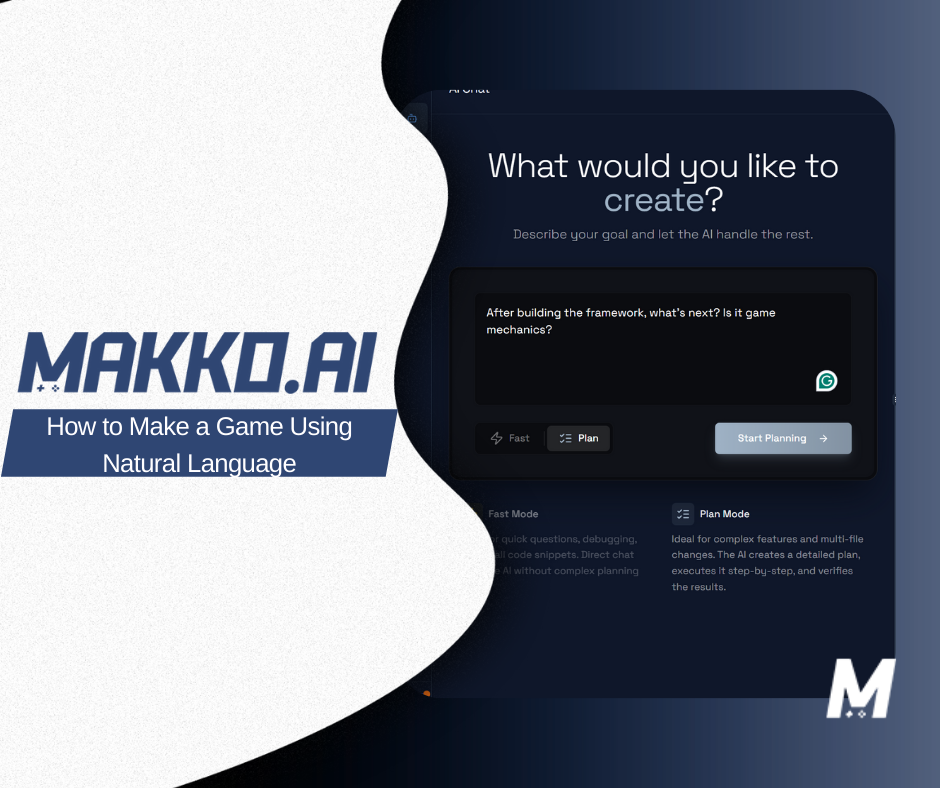
Natural language game development is a methodology that uses reasoning-capable AI to interpret plain-English prompts and translate them into functional game mechanics and assets. In 2026, this approach is not about "instant" creation but about removing the boilerplate technical friction that historically consumed 80% of an indie developer's time. By describing high-level intent—theme, character behavior, and win/loss rules—creators use an AI game development studio to automate the assembly of code and assets into a single playable environment. Our leadership team, drawing on decades of experience at Xbox, EA Sports, Amazon, and PAX, built Makko.ai specifically to bridge the "Implementation-Intent Gap." This article provides a step-by-step framework for using natural language to accelerate the prototyping phase, allowing designers to move from raw vision to a functional game loop without the traditional barriers of manual syntax.
New to Makko? See how it works.
Step 1: Choosing an AI-Native Development Platform
The first step in making a game with natural language is selecting an environment built for AI-native workflows. Traditional engines like Unity or Godot are runtimes for code, whereas an AI studio is a partner in the assembly process. To effectively reduce development time, the platform must support three core functions: intent-driven input, where the system interprets "What" you want to build; integrated asset generation, where characters and environments are created within the workspace; and system orchestration, where the AI manages the relationships between independent game rules. In 2026, this foundation is essential for preventing the "Code Wall" that stalls prototypes. By leveraging a studio environment, creators can move from idea to initial build in a fraction of the time, focusing their energy on design and player experience rather than low-level engine configuration.
Step 2: Describing Core Gameplay through Intent
Once your project is initialized, the focus shifts to describing your game concept using outcomes rather than implementation details. Instead of planning a script, you define the player's goals and the core gameplay loop in plain English. For example, a "fantasy platformer" description should specify the movement mechanics, the nature of the obstacles, and the reward system. This outcome-based prompting allows the AI to plan the required systems—such as collision detection and state management—behind the scenes. Our team’s background at EA Sports and Xbox taught us that the most successful games are built on well-articulated mechanics; natural language tools simply provide the shortcut to realizing those mechanics. By focusing on intent early, creators ensure that the AI builds a foundation that is logically consistent and ready for high-level iteration.
Example Prompt Frameworks
- Genre Definition: "A top-down survival game where resources deplete over time."
- Player Goals: "The hero must collect ten gems to unlock the final scene."
- Difficulty Scaling: "Increase enemy speed by 5% every minute the player survives."
Step 3: Assembling System Logic Without Manual Scripting
Defining game logic through conversation relies on agentic AI to perform multi-step planning and system orchestration. Instead of writing isolated scripts for every interaction, the creator provides descriptive instructions such as "End the game when player health reaches zero" or "Spawn an enemy every ten seconds." The AI analyzes these goals, identifies the required variables, and assembles the event-driven triggers needed for playability. In 2026, this workflow replaces the need for deep syntax knowledge with the ability to articulate systemic relationships. Our internal benchmarks demonstrate that using agentic chat to build logic loops reduces manual wiring errors by 70%. By maintaining constant state awareness, the AI ensures that new logic additions do not conflict with existing systems, effectively managing the architectural complexity that often leads to "State Drift."
Step 4: Conversation-Driven Refinement and Iteration
Iteration is the primary benefit of a natural language workflow, enabling creators to refine game difficulty, pacing, and visuals through follow-up prompts. Unlike traditional engines where a single mechanic change might require refactoring dozens of files, an AI-native workflow identifies only the specific modules needing adjustment. This process, supported by AI-assisted iteration, allows for rapid experimentation without the risk of breaking independent systems. Designers can add constraints—such as specific quantities, timing windows, or collision boundaries—simply by updating their description of the game state. In 2026, this conversational feedback loop is the definitive tool for solving "The Prototype Bottleneck." By reducing the time spent on manual debugging and code maintenance, creators can focus exclusively on finding the "fun" in their mechanics, accelerating the journey from a basic concept to a polished, playable experience.
Related Reading
- AI Game Generator From Text
- How Agentic AI Chat Builds Game Logic
- Can You Build Game Logic Without Coding?
- What Is an AI Game Development Studio?
Accelerate Your Development Cycle
If you want to spend less time on manual boilerplate and more time on game design, Makko provides the AI-native environment designed to turn intent into gameplay.
Ready to accelerate your development? Start Building Now.
For detailed walkthroughs, visit the Makko YouTube channel.