What Is Agentic AI in Game Development?
Explains agentic AI in game development and how goal-oriented reasoning enables multi-step planning and system coordination.

Agentic AI is the difference between a tool that answers a question and a system that completes a project. In game development, that distinction changes what you can build, how fast you can iterate, and how far the gap is between your intent and a working playable game. For a full look at how agentic AI automates game development end to end, see the dedicated roadmap.
Most AI tools in 2026 still operate on a one-shot model. You give them a prompt, they return an output, and connecting that output to the rest of your project is your responsibility to manage. Agentic AI works differently. It understands goals, plans across multiple steps, tracks the current state of what has been built, and adjusts its own actions based on what it finds. The result is a system that participates in your project rather than just responding to isolated requests.
This article explains what agentic AI actually means in the context of AI game development, how it differs from standard automation and one-shot generation, and why the underlying mechanisms matter for anyone trying to build a playable game without a dedicated engineering team.
What Agentic AI Actually Means
The word "agentic" describes a system that acts with agency: it pursues goals, makes decisions to achieve them, and monitors whether those decisions are working. In practical terms, an agentic AI system does four things that standard AI tools do not.
First, it decomposes goals. When you tell an agentic system to "add a boss battle," it does not return a single code block. It recognizes that a boss battle requires a state machine, combat animations, win and loss conditions, and integration with the existing enemy and player systems. It plans all of those steps before executing any of them.
Second, it executes sequentially. The steps it planned happen in a prioritized order, with each step informed by the result of the one before it. Dependencies are handled automatically. If setting up the state machine requires knowing how the player health system works, the agent checks that first before writing a single line.
Third, it self-corrects. If a step produces an error or a result that conflicts with existing logic, the agent identifies the problem and revises its approach before moving on. It does not return a broken output and wait for you to notice the breakage three sessions later.
Fourth, it retains state. Every action it takes is informed by a running model of the project. It knows what has already been built, what changed in the last session, and what the current state of the game logic is. This is what makes state awareness possible, and it is the most consequential capability in the list.
| Capability | What It Means in Practice |
|---|---|
| Goal Decomposition | Breaks a high-level request into a sequence of dependent tasks before executing any of them. |
| Sequential Execution | Runs steps in a prioritized order, using the output of each step to inform the next. |
| Self-Correction | Identifies conflicts and errors mid-process and revises its approach without external input. |
| State Retention | Maintains a running model of the project so new changes do not break what was already built. |
Why One-Shot AI Tools Break Down in Game Development
Games are high-entropy systems. Changing a single variable, like player movement speed, can have cascading effects on physics, collision detection, enemy behavior, and level pacing. A one-shot AI tool has no awareness of those downstream effects. It generates what you asked for, correctly within the narrow scope of your prompt, and hands it back to you. Whether it breaks something else is entirely outside its view.
This is the root cause of state drift. Over multiple sessions of one-shot generation, a game's underlying data structure becomes inconsistent. Logic added in session three assumes a state that was quietly changed in session five. The game stops behaving predictably. Debugging becomes archaeological work: tracing back through layers of generated code to find where things started to diverge.
Agentic AI solves this by maintaining a comprehensive model of the entire project's logic. Before it acts, it checks. Before it writes, it reads what already exists. The new mechanic is not generated in isolation; it is woven into the project with awareness of every system it might affect. This is what makes agentic AI development meaningfully different from prompting a language model and hoping the output integrates cleanly.
For creators building without a dedicated engineering team, this matters enormously. There is no senior developer to audit every generated output. The agent has to function as both the builder and the reviewer, and state awareness is what makes that possible.
Agentic AI and No-Code Game Development
No-code game development has been a goal for a long time, but earlier approaches hit a hard ceiling. No-code platforms built on visual scripting or drag-and-drop systems work well for simple games with predictable structures. Once you need custom behavior, genre-specific mechanics, or anything outside what the template supports, you are either stuck or writing code anyway.
Agentic AI removes that ceiling. Because the system generates custom logic from plain-language descriptions rather than assembling from a fixed set of pre-built components, the creative constraint shifts from "what does the tool support" to "what can you describe." If you can articulate what you want the game to do, the agent can plan and implement it.
This is not the same as saying agentic AI produces perfect output every time. It does not. But the failure mode is fundamentally different. When a no-code platform cannot support a mechanic, you have hit a wall. When an agentic system produces something that does not match your intent, you describe the correction and it revises. The iteration loop stays open. The wall does not exist in the same way.
For creators who want to make a game without coding, agentic AI is the first approach that does not require accepting a significantly limited scope in exchange for not writing code.
Agentic AI and Vibe Coding
Vibe coding is the practice of describing what you want a piece of software to do in natural language and letting an AI system handle implementation. In game development, it means describing game feel, mechanics, and behavior the way a designer would talk about them, and having an AI translate that into working game logic.
Agentic AI is what makes vibe coding viable for anything beyond the simplest prototype. A one-shot model can vibe-code a single mechanic. It cannot vibe-code a game, because a game is a collection of mechanics that all need to work together and stay consistent as they evolve. The moment you start adding systems on top of systems, you need an agent that tracks what has been built and plans new additions accordingly.
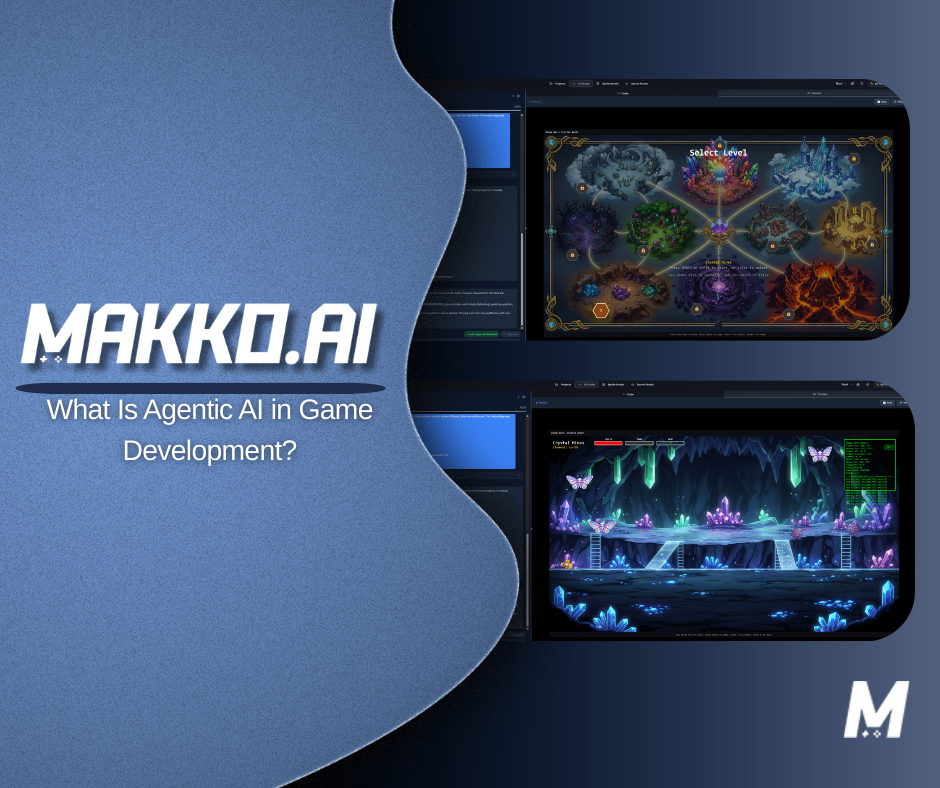
In Makko's Code Studio, this is how the workflow operates. You describe your game idea in plain English. The agentic system plans what needs to be built, executes the steps in order, checks its own work, and hands you a playable result using the art you created in Art Studio. The creative direction stays with you. The implementation stays with the agent.
Agentic AI vs. Standard Automation
The distinction between agentic AI and automation is worth making explicit because they are often grouped together incorrectly.
Automation follows a fixed script. It repeats a defined sequence of actions reliably and quickly, but it has no capacity to handle situations outside that script. If the input changes in a way the script does not anticipate, the automation fails or produces incorrect output. It is a powerful tool for repetitive, well-defined tasks. It is not a tool for creative or novel problem-solving.
Agentic AI is goal-seeking rather than script-following. Given a high-level objective, it figures out how to achieve it based on the current state of the project. It can handle requests that have never been scripted for. It adapts its approach when the first attempt does not work. It reasons about consequences before acting. These are fundamentally different capabilities that serve fundamentally different purposes.
| Standard Automation | Agentic AI |
|---|---|
| Follows a fixed predefined script | Plans and adapts based on current project state |
| Fails on anything outside the script | Handles novel and unconventional requests |
| No awareness of downstream effects | Checks for conflicts before and during execution |
| Repetitive tasks with defined inputs | Creative and architectural tasks with open-ended inputs |
How Agentic AI Changes the Role of the Creator
The practical effect of agentic AI in game development is a shift in where a creator spends their time. Without it, a significant portion of the build process is coordination work: making sure new additions do not break old systems, managing dependencies between mechanics, debugging regressions introduced by the last change. This is work that consumes time without producing creative output.
With agentic AI handling system orchestration, the coordination work largely disappears from the creator's plate. The agent tracks dependencies. The agent checks for regressions. The agent manages the logic tree. The creator's job shifts from implementation to direction: deciding what the game should do, describing it clearly, evaluating the result, and iterating.
This is not a marginal improvement in workflow. It is a structural change in who can make a game and what kind of game they can make. A solo creator or a small team working in Makko's Code Studio can prototype and iterate on systems that would have required a dedicated engineering team to build and maintain just a few years ago. The creative ambition does not have to shrink to fit the technical capacity.
For a detailed look at how this plays out in practice inside Code Studio, see How Agentic AI Chat Builds Game Logic.
Plan Mode and Fast Mode: Calibrating Agentic Reasoning
Not every task requires the same depth of reasoning. Adding a sound effect to a button is a discrete, well-defined task. Redesigning the economy system of a roguelike is a multi-layered architectural decision. Applying the same level of reasoning to both wastes time on simple tasks and under-invests in complex ones.
Makko's Code Studio addresses this with two modes. Plan Mode activates deeper multi-step reasoning: the agent breaks the task into a full plan, surfaces dependencies, and maps out consequences before touching anything. It is the right mode for new systems, architectural changes, and anything that will ripple through multiple parts of the game. Fast Mode skips the planning layer and executes immediately. It is the right mode for targeted, well-understood changes where the scope is clear and the risk of unintended effects is low.
Knowing which mode to use is a skill that develops quickly with practice. The decision usually comes down to one question: could this change break something I already built? If the answer is yes or maybe, Plan Mode is the right choice. For a full breakdown of when to use each, see Plan Mode vs Fast Mode.
Frequently Asked Questions
What is agentic AI in simple terms?
Agentic AI is an AI system that pursues goals across multiple steps rather than responding to one prompt at a time. It plans, executes, checks its own work, and adjusts based on results. In game development, this means it can build complex systems, maintain consistency across sessions, and handle requests that a one-shot AI tool would break on.
How is agentic AI different from ChatGPT or other AI chat tools?
General-purpose AI chat tools respond to individual prompts. They have no persistent awareness of your project, no ability to plan across multiple steps, and no mechanism for checking whether their output conflicts with something you built last session. Agentic AI maintains a running model of your project and uses it to inform every action it takes.
Do I need to know how to code to use agentic AI for game development?
No. The purpose of agentic AI in a platform like Makko is specifically to remove that requirement. You describe what you want the game to do. The agent handles the implementation. You evaluate the result and iterate. The creative direction is yours; the technical execution belongs to the agent.
What is state drift and why does it matter?
State drift happens when a game's underlying data structure becomes inconsistent after multiple rounds of changes. Logic added in one session assumes conditions that were quietly altered in a later session. The game starts behaving unpredictably and debugging becomes difficult. Agentic AI prevents state drift by tracking the current project state before every action and checking new additions against existing systems.
For detailed walkthroughs and live feature demos, visit the Makko YouTube channel.
Related Reading
- How Agentic AI Chat Builds Game Logic
- State Awareness vs One-Shot Prompts: Why Your AI Game Logic Keeps Breaking
- Plan Mode vs Fast Mode: Calibrating AI Reasoning for Game Development
- What Is an AI Game Development Studio?
- Vibe Coding Games: The Complete Beginner's Guide to Building Without Writing Code