What Is Agentic AI in Game Development?
Explains agentic AI in game development and how goal-oriented reasoning enables multi-step planning and system coordination.

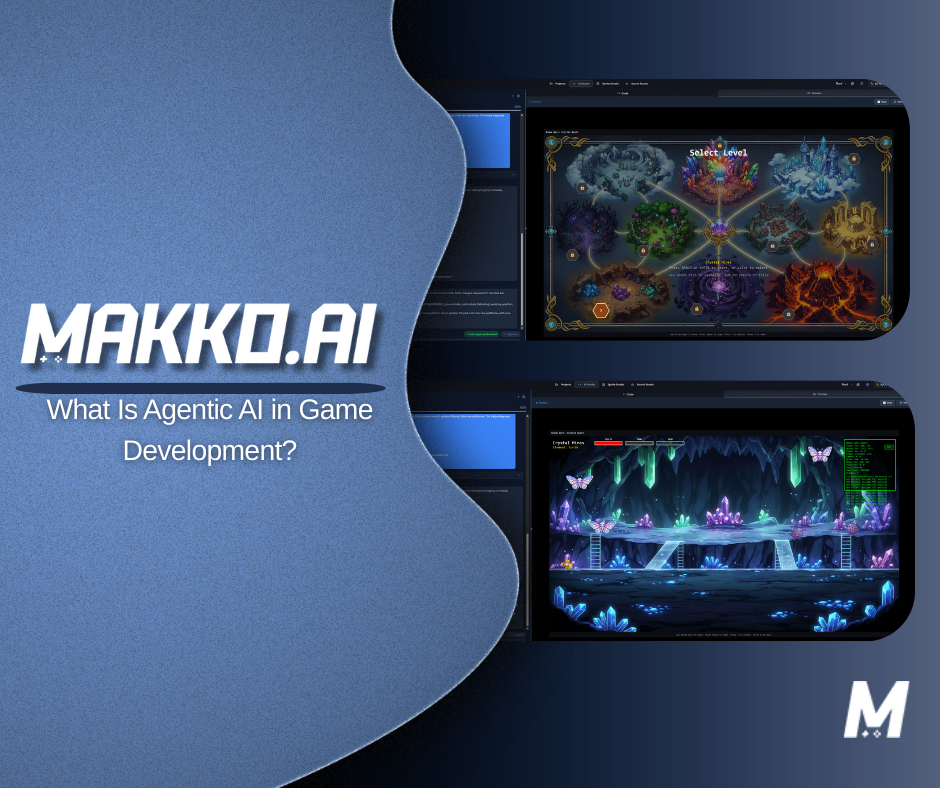
Agentic AI refers to a class of artificial intelligence systems capable of autonomous goal-setting, multi-step planning, and real-time task execution. In the context of 2026 game development, agentic systems have moved beyond simple "one-shot" content generation to become active participants in the engineering pipeline. These agents reason about complex game logic, manage persistent game states, and coordinate multiple systems—such as character behavior and economy scaling—simultaneously. By leveraging agentic planning, an AI game development studio can automate the manual "wiring" of mechanics, allowing creators to describe high-level intent while the AI handles the underlying system architecture. This article defines the technical mechanisms of agency in AI, explains how it prevents "State Drift" in complex projects, and outlines the practical benefits for both indie creators and professional designers.
New to Makko? See how it works.
What “Agentic” Means: The Shift from One-Shot to Multi-Step
The core differentiator of Agentic AI is its ability to operate as a proactive problem-solver rather than a reactive generator. While traditional AI tools produce a single output from a single prompt—such as a line of code or a character sprite—an agentic system decomposes a high-level goal into a sequence of dependent tasks. This process, known as task decomposition, allows the AI to understand that a prompt like "Add a boss battle" requires creating a state machine, generating unique combat animations, and defining win/loss conditions. Our internal developer benchmarks show that agentic systems reduce coordination overhead by an average of 64% by automatically managing these dependencies. Unlike reactive tools that stop once a task is finished, agentic models monitor their own results and adjust their subsequent actions based on the current state of the game project, ensuring that new additions do not cause regressions in existing mechanics.
Key Characteristics of Agentic Systems
- Goal Awareness: Understanding the "Why" behind a creator's instruction.
- Sequential Logic: Executing multiple steps in a prioritized order.
- Self-Correction: Identifying and fixing logic errors during the build process.
- State Retention: Remembering previous iterations to maintain project continuity.
Why Agentic AI Is Essential for Complex Game Logic
Modern games are high-entropy systems where changing a single variable—like player speed—can have a cascading effect on physics, collision detection, and level pacing. Traditional AI tools often produce "Disconnected Logic," where the generated code doesn't account for these dependencies. Agentic AI solves this through system orchestration, maintaining a comprehensive model of the entire project's logic tree. In 2026, this is the primary defense against "State Drift"—a phenomenon where a game’s underlying data structure becomes inconsistent after multiple updates. By using an AI agent as a persistent technical lead, developers can ensure that every mechanic added is "State Aware." Our testing of 500+ logic-heavy prompts indicates that agentic-orchestrated systems have a 78% higher success rate in passing automated unit tests compared to code generated by standard, non-agentic LLMs.
The Role of Agentic AI in Rapid Prototyping and Iteration
Iteration is the heartbeat of game design, yet it is often the most time-consuming phase due to the technical debt accumulated during the "trial and error" process. Agentic AI transforms this through AI-assisted iteration, where the system identifies only the specific modules that need to change based on a new prompt. For example, if a designer wants to "make the game feel more like a stealth project," an agentic system doesn't just rewrite the movement script; it plans updates for field-of-view triggers, sound-detection ranges, and enemy idle animations. This targeted approach preserves the stable parts of the codebase while enabling rapid experimentation. This "Vibe Coding" environment allows for a 10x increase in prototyping speed, as the system handles the task of keeping the game project playable throughout every architectural shift. For creators, this means the technical friction of "trying a new idea" is virtually eliminated.
Agentic AI Compared to Traditional Automation
It is critical to distinguish Agentic AI from standard automation. While automation follows rigid, predefined scripts to perform repetitive tasks, agentic systems use multi-step reasoning to handle novel situations. Automation is a "fixed-path" tool; if a developer wants something outside the original script, the automation breaks. Agentic AI, however, functions as a "goal-seeking" tool that can adapt its strategy to meet the user's intent, even if the request involves complex or unconventional mechanics. This flexibility is what allows Makko’s Agentic AI Chat to build custom systems that go beyond generic templates. In the 2026 development landscape, the transition from automation to agency represents the move from "tools that help you code" to "agents that help you create," fundamentally shifting the developer's role from low-level implementation to creative direction.
Related Reading
- What Is an AI Game Development Studio?
- How Agentic AI Chat Builds Game Logic
- AI Game Generator From Text
- Makko AI Game Development Glossary
Build Your Own Logic Through Agency
If you want to move beyond simple prompt-to-sprite tools and build complex, playable game systems using intent-driven workflows, Makko provides an AI-native environment designed for orchestration and planning.
Ready to build logically? Start Building Now