What Is an AI Game Development Studio? The 2026 Definition
Defines what an AI game development studio is, how it differs from engines and generators, and what problems it actually solves.

Pillar — AI Game Development Studio
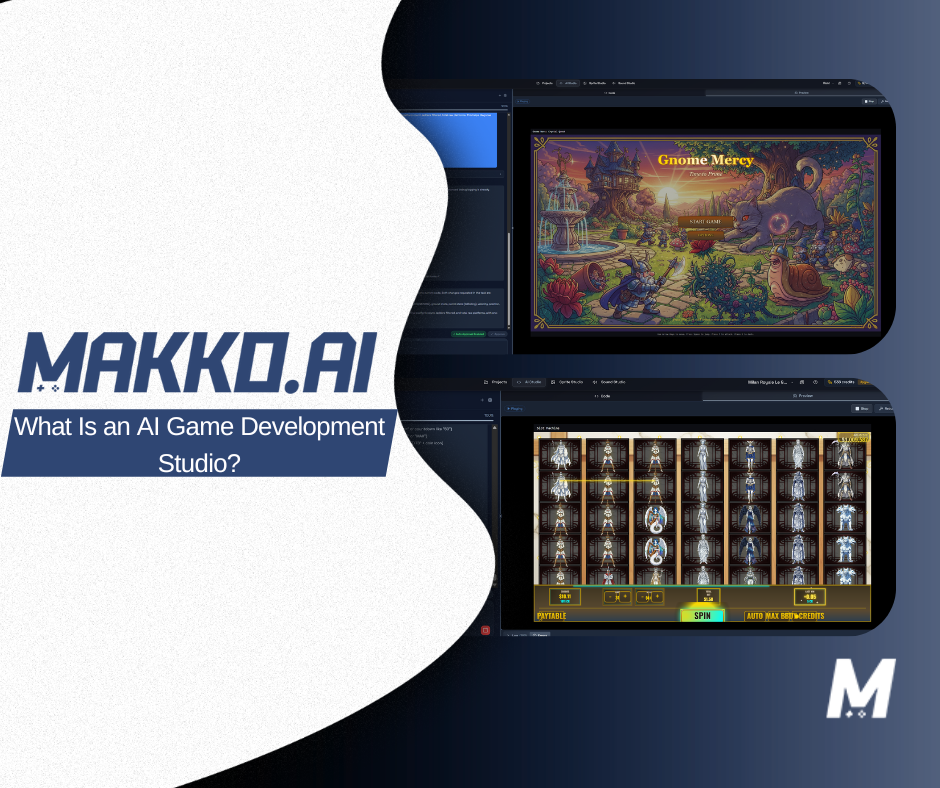
An AI Game Development Studio is a software environment where AI serves as an active participant in building a game — not just a code generator you paste from.
In a traditional engine like Unity or Godot, you write the code, wire the systems, and manage every dependency yourself. In an AI-native studio, you describe what the game should do, and the AI handles the assembly.
The key difference is where the work happens. Traditional engines move fast once you know them. They are slow for everyone else — and slow for anyone who wants to test an idea before committing to an architecture.
New to Makko? See how it works.
Want to see how an AI Development Studio functions?
How It Differs From No-Code Tools
No-code platforms let you configure from a fixed menu. If the feature is not listed, it cannot be built.
An AI-native studio generates custom logic from your description. You are not picking from templates — you are defining behavior, and the AI builds the systems behind it.
This is what the Implementation-Intent Gap refers to: the distance between what a creator wants to build and what they can actually execute using traditional tools. An AI studio closes that gap by translating intent directly into working game systems.
What an AI Studio Actually Does
Three things separate a real AI studio from a simple prompt-to-game tool:
| Capability | What It Means in Practice |
|---|---|
| State Awareness | The AI tracks what has already been built so new changes do not break existing mechanics. |
| System Orchestration | When you add a level-up system, it understands how that affects enemies, UI, and player stats simultaneously — not in isolation. |
| Integrated Asset Pipeline | Sprite generation, animation, and logic live in the same workspace. No external file management required. |
This combination is what makes an AI studio different from a wrapper around a language model. The reasoning layer maintains game state across every iteration, preventing the state drift that causes most AI-built games to collapse under real gameplay conditions.
When to Use an AI Studio
Use an AI studio when you are validating an idea, prototyping a core gameplay loop, or building without a dedicated engineering team.
It is not a replacement for Unity on a production-scale game. It is a replacement for the weeks you would spend before you know if the idea is worth building at all.
| Choose Makko if... | Choose a traditional engine if... |
|---|---|
| You want to move from idea to playable without writing code | You need deep engine-level customization or multiplayer infrastructure |
| You are iterating on design, not architecture | You are shipping a long-lifecycle, production-scale game |
| You are solo or in a small team without dedicated engineers | You have a full engineering team and a defined tech stack |
Many teams use Makko to prototype and validate ideas before transitioning to Unity or Godot for full production. See how that decision plays out in Makko vs Unity and Makko vs Godot.
Related Reading
- What Is Agentic AI in Game Development?
- Makko vs Unity: When AI Replaces Manual Scripting
- AI Game Generator vs Game Engine: What You Are Actually Choosing
- How Prompt-Based Game Creation Works
- State Awareness vs One-Shot Prompts: Why Your AI Game Logic Keeps Breaking
Scale Your Production Today
Stop writing manual boilerplate. Makko's agentic AI orchestrates your game systems — from logic and state to assets and animation — so you can focus on what the game should actually do. Every iteration stays consistent. Every change builds on what came before.
Want to see it in action first? Technical walkthroughs and live demos are on the Makko YouTube channel.