How to Make a Game Without Coding

The most common assumption people bring to game development is that it requires coding. That assumption is not unreasonable — for most of the history of the medium, writing code was the only way to tell a computer what a game should do. If you could not write scripts, define logic, and manage state in a programming language, you could not build a game. Someone else had to do it for you.
That is no longer true. Not because game development has gotten simpler, but because a new layer has been added between your intent and the implementation. Agentic AI can now interpret what you want a game to do, plan the systems required to make it work, build them in the correct order, and maintain the connections between them as the project evolves. The implementation layer still exists. You just no longer have to live in it.
This guide walks through the full pipeline for building a game in Makko without writing code — from creating a character in Sprite Studio through generating animations, building a manifest, planning game logic in AI Studio, and reaching a working playable build. The example used throughout is an endless runner, but the same pipeline applies to platformers, visual novels, puzzle games, and any other 2D game type.
If you want to follow along in real time, the video walkthrough below shows the entire pipeline from start to finish — character creation through a working game with animations integrated and a runtime error debugged — in a single session.
For definitions of terms used throughout this guide, see the Makko AI Game Development Glossary.
What You Are Actually Replacing
It is worth being precise about what "no coding" means in this context, because the claim can mean different things depending on the tool making it.
Some no-code tools replace coding with visual scripting — you connect nodes in a graph instead of writing syntax, but you are still defining logic manually. Some tools replace coding with templates — you fill in values and the system generates a predetermined type of game. These are valid approaches, but they have a ceiling. The moment your game needs something the template does not support, you are blocked.
Makko's approach is different. The agentic AI chat builds the logic from your description of what the game should do. You describe intent. The AI generates the implementation. When something needs to change, you describe the change. The AI updates the implementation. At no point do you interact with the underlying code directly — not because the code does not exist, but because the AI is the interface between your intent and the code.
This means the ceiling is much higher. Any game mechanic you can describe clearly, the system can attempt to build. The constraint is not the tool's template library. The constraint is the clarity of your description.
That is a fundamentally different kind of intent-driven game development — and it is what makes the no-code claim meaningful rather than just a marketing shortcut.
Part 1: Creating Your Character in Sprite Studio
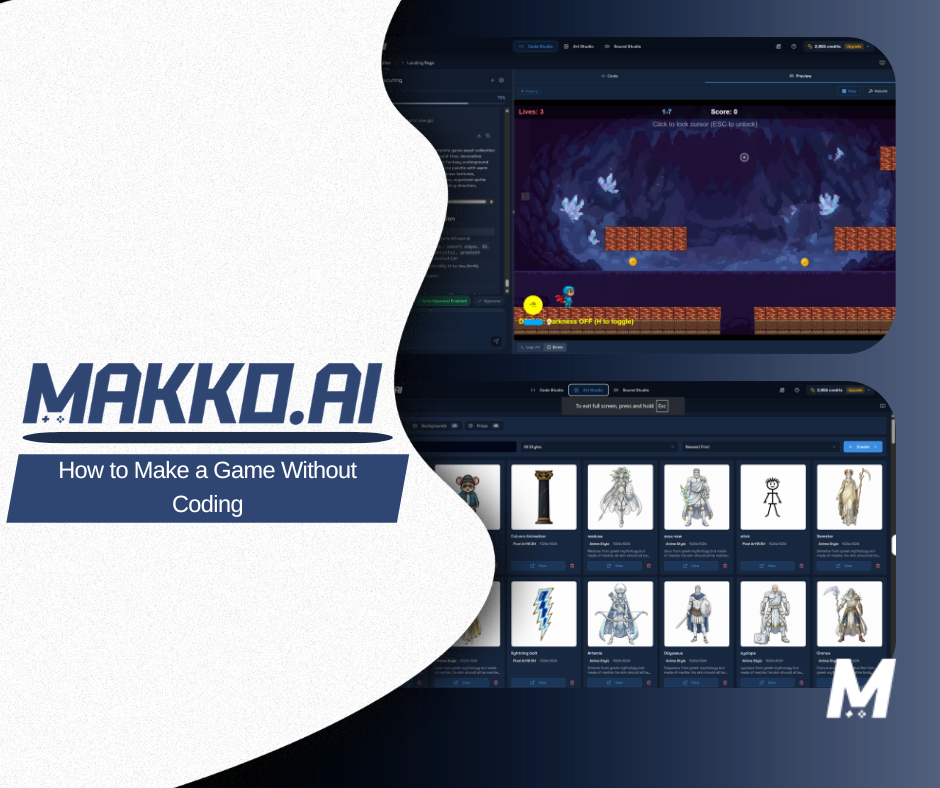
The pipeline starts in Sprite Studio, where your character is created before any game logic is touched. Open Sprite Studio from the Makko header and click Create Character. Give your character a name — keep it clear and consistent, because this name will carry through your manifest and asset library.
In the description field, be specific. The AI uses your description as the primary input for generating concept art, so the more detail you provide about silhouette, outfit, color palette, and visual tone, the closer the output will be to what you actually want. For the endless runner example: a track runner with red clothes, black shoes, and a headband, generated in anime art style.
Click Generate Character Concepts. You will get four options. If one is close but not perfect, use the refresh icon on that specific concept to iterate without regenerating all four. Once you have found the look you want, select it and click Generate Reference Sheet. Makko produces a clean front, side, and back view. Review all three — this is the visual reference the AI uses when generating animations, so any issues here will carry through to the animations. If everything looks right, save the character.
Your character is now ready for animation. No illustration software. No asset export pipeline. No manual rigging. The reference sheet is the foundation and the AI built it from your description.
Part 2: Generating and Editing Animations
With the character saved, click Create Animation. Name the animation clearly — walk, run, jump — and write a description of the motion you want. For a side-scrolling endless runner, descriptions like "side view running from left to right" give the AI a clear spatial reference to work from.
Choose Simple or Complex depending on the animation. Simple works well for looping actions like walking or idle states. Complex is better for multi-pose or effect-heavy animations. Click Generate. Makko renders a preview video. You can start generating additional animations while the first one processes — there is no need to wait.
For the endless runner, three animations were generated: running, walking, and jumping. A jogging animation was also attempted but did not come out correctly — it looked faster than the running animation rather than slower, which was the opposite of the intended result. That animation was deleted and replaced with a proper walk cycle. This is a normal part of the process. Not every generation will be exactly right. The workflow is: generate, review, keep or discard, iterate.
Once an animation preview looks right, extract the frames. Open the frame editor using the film strip icon. This is where you clean the animation — deleting frames where the character stands still, tightening the loop so it plays without a stutter. For the running animation, the first eight frames were standing frames and were removed. For the jump, frames at the start and end needed trimming to get a clean arc. Work through each animation and remove anything that disrupts the loop.
After the frames are clean, scroll to Baked Sprite Sheets and create a new sheet. Name it clearly with no spaces — run, walk, jump. Bake the sheet. Repeat this for every animation. Each animation becomes its own baked sprite sheet, ready to be bundled into the character manifest.
The whole process — three animations generated, reviewed, cleaned, and baked — takes a matter of minutes. What would have required a dedicated animator, an animation software license, and a manual export pipeline now happens through description and review.
Part 3: Building the Character Manifest
Once all animations are baked, build the character manifest. In the left panel under your reference images, open Character Manifest and click the plus icon. Name the manifest clearly — something like CharacterNamePlayerCore with no spaces. Then select all the sprite sheets that belong to this character and click Create Manifest.
The manifest is the container that defines everything this character can do. It bundles all the animations together so AI Studio knows what animations exist, what they are called, and how to reference them when building game logic. Without a manifest, the AI cannot connect your animations to the game's state management system.
One manifest per character. Include only animations that belong to that character. If you are building a game with multiple characters, repeat the entire process — character creation, animations, baking, manifest — for each one before moving into AI Studio.
Part 4: Planning the Game in AI Studio
With the character manifest ready, create a new project and open AI Studio. You will land in the agentic AI chat interface. For a new project, choose Plan Mode. This tells the AI to perform task decomposition before building anything — mapping out the full system structure, identifying dependencies, and producing an implementation plan for you to review before any code is written.
Your first prompt should describe what the game is and what it needs to do. For the endless runner: "Create an endless runner where our character can walk, jump, and run until the end of time. The character runs along a track with a clear blue sky." This gives the AI the core loop, the player actions, and the visual context it needs to start planning.
The AI will ask clarifying questions before generating the plan. For the endless runner, it asked about character style (geometric placeholder or sprite-ready placeholder), obstacle types, control inputs, difficulty progression, and scoring. Answer these directly and concisely. The AI is gathering the information it needs to build the right system — not a generic endless runner, but the specific one you described.
For the character style question, the correct answer is to request a placeholder system that can be swapped for your existing manifest. This tells the AI to build the animation logic with hooks for your character rather than generating its own placeholder assets that would need to be removed later.
Once all questions are answered, the AI generates a Proposed Plan. Review it carefully. Confirm the goal matches what you described, the approach makes sense for your vision, and the execution tasks cover everything the game needs. If something is wrong, reject the plan and describe the issue. If everything looks right, approve it.
After approval, the AI works through each task in sequence — canvas setup, character logic, obstacle generation, collision detection, scoring, difficulty progression — completing and confirming each one before moving to the next. You review each step as it completes. If a step looks correct, approve it. If something does not match your intent, push back before moving on. The system maintains state awareness across the entire build — every approved step informs the next one.
Part 5: First Preview, Errors, and Fixing Them
When all tasks complete, click Preview, then Rebuild, then Play. This is the first time you see what the AI has built. At this stage it is normal to encounter runtime errors. Do not interpret errors as a failure of the build — they are a normal part of the iteration loop and most of them are fixed without you touching any code.
For the endless runner, several runtime errors appeared after the first build. The fix was a single click: the Fix All button. Clicking it presents a plan showing what the AI intends to fix, the approach it will take, and the steps it will execute. Review the plan, approve it, and the AI works through the fixes in sequence. Enable auto-approve if you want to let the AI move through steps without pausing for confirmation on each one.
After the fixes are applied, stop the build, rebuild, and press Play. The result for the endless runner was a working game — rocks and holes appearing as obstacles, space bar for jump, shift for run, a scoring system tracking distance and obstacles avoided, and difficulty increasing over time. All of it built from a natural language description without writing a line of code.
If errors persist after the automatic fix, describe the specific issue to the AI in chat. Be precise: what you see, what you expected, and any error message from the console. The AI will diagnose and correct. This conversational debugging loop is how prompt-based game creation handles issues that in a traditional engine would require reading documentation, finding the relevant script, understanding its dependencies, and manually editing the logic.
Part 6: Adding Your Character Animations to the Game
With a working game build, the final step is replacing the placeholder character with your animated one from Sprite Studio. Go to Quick Actions and select Add a Character. If the system reports no character manifest found in the project, open the Asset Library, find your character, click the three dots, and select Add to Project. This registers the manifest with the project so the AI can reference it.
Return to Quick Actions, select Add a Character, choose your manifest from the list, and click Generate Prompt. The AI integrates the character and its animations into the game's existing logic. Rebuild and press Play.
At this point your character should be visible in game with animations playing — walking when moving at normal speed, jumping when the jump input is triggered. If a specific animation is not triggering correctly, describe the issue to the AI. For the endless runner, the run animation was not activating on shift. The fix was a single chat message: "The shift button is not activating the run animation. Ensure that when a player presses shift, the character starts running and also moves faster." After a rebuild, the run animation worked correctly.
This is the complete pipeline. Character concept to reference sheet to animations to sprite sheets to manifest to game logic to playable build — entirely through natural language, with no code written at any point in the process.
Watch the Full End-to-End Walkthrough
The video below shows the entire pipeline in real time — from creating the character in Sprite Studio through a working endless runner with animations integrated — so you can follow along directly in your own project.
What Game Types You Can Build This Way
The endless runner is one example of what this pipeline produces. Makko supports 2D game development broadly — the agentic AI can build game logic for any mechanic you can describe clearly in natural language.
For creators who want a starting point rather than building from scratch, Makko includes project templates for common game formats: stomp platformers, Mega Man-style action platformers, visual novels, board game formats like Monopoly and Settlers of Catan, and slot machine mechanics. Templates give you a working foundation to extend rather than starting from an empty project. You still use the same agentic chat workflow to customize, extend, and debug — the template just reduces the initial planning and scaffolding time.
For more open-ended projects — games that do not fit a template, or ideas that require custom mechanics — the Plan Mode workflow described in this guide handles them the same way. Describe the game clearly, answer the AI's clarifying questions, review the plan, approve it, iterate on the result. The game type does not change the workflow. The workflow is always: describe intent, review output, refine.
The honest constraint is complexity. Simple game loops with a small number of mechanics and a clear visual style are faster and more reliably built than deeply complex systems with many interdependencies. As with any tool, the output quality scales with the clarity of the input. The more precisely you can describe what you want and why, the closer the first build will be to what you envisioned.
Why This Is Different From Traditional No-Code Tools
Most no-code game tools work by giving you a constrained system and letting you configure it. You pick a template, adjust parameters, and publish within the limits of what the template supports. That works well for the game types the template was designed for. It stops working the moment you need something outside those limits.
Makko's approach is to build the game from your description rather than from a configuration of a preset. The agentic AI generates the actual game logic — the code that runs the game loop, manages state, handles input, tracks scoring, and renders assets — based on what you told it the game should do. That logic is real and specific to your game, not a configuration of someone else's system.
This is also why the iteration loop works the way it does. When you describe a change to the AI, it updates the actual game logic rather than adjusting a parameter. When you describe a bug, it reads the relevant code and fixes it. You are not configuring a preset — you are directing a system that builds and maintains real game code on your behalf.
For creators who have tried no-code tools before and hit their ceiling, this distinction is the relevant one. Makko is not a more polished configuration tool. It is a different approach to who does the implementation work.
Pipeline Checklist: Zero to Playable Game
- Create character in Sprite Studio. Name it, write a specific description, choose art style, generate concepts, select the best result, generate reference sheet, save.
- Generate animations. One animation at a time: name it, describe the motion, choose Simple or Complex, generate, review. Delete and redo any that do not work. Repeat for every animation the character needs.
- Extract and clean frames. For each animation: set frame rate and size, open frame editor, remove standing frames and loop stutters, tighten the loop.
- Bake sprite sheets. One sheet per animation, no spaces in names. Repeat for every animation.
- Build character manifest. Select all sprite sheets for this character, name the manifest, create it. One manifest per character.
- Create project and open AI Studio. Choose Plan Mode for new projects.
- Describe the game. Tell the AI what it is and what it needs to do. Answer clarifying questions directly. Request a placeholder system for character animations so your manifest can be swapped in.
- Review and approve the implementation plan. Verify goal, approach, and task list match your intent before approving.
- Step through implementation. Review and approve each task as it completes. Flag anything that does not match before moving on.
- Preview, rebuild, fix errors. Use Fix All for runtime errors. Approve the fix plan. Rebuild and retest.
- Add character via Quick Actions. Add manifest to project via Asset Library first if not already added. Use Add a Character, select manifest, generate prompt. Rebuild.
- Debug specific animation issues via chat. Describe exactly what is not working and what you expected. Rebuild after each fix.
For more walkthroughs and live demos across all Makko features, visit the Makko YouTube channel.