How Agentic AI Automates Game Development: A Roadmap for Task Orchestration
Outlines how agentic AI automates game development tasks through planning, orchestration, and persistent context.

The term "automation" in game development has historically meant something narrow: macros, build scripts, asset batch processors. Tools that repeat a defined task faster than a human could. Useful, but not intelligent. They do exactly what they are told, and nothing more.
Agentic AI is a different category entirely. Rather than executing a fixed sequence of steps, agentic systems understand goals, plan the actions required to reach them, and carry those actions out across multiple steps, adapting as conditions change. In game development, this distinction matters enormously. The work that consumes the most time in a traditional pipeline is not repetitive in the scripted-macro sense. It is coordination work: figuring out which systems need to talk to each other, in what order, with what dependencies. Writing that coordination by hand is what fills the weeks between having a game idea and having something playable. Agentic AI automates the coordination layer itself, and that is exactly what the brick-by-brick approach to game development is built on.
This article breaks down exactly how that works: which tasks agentic AI automates, how the underlying planning and orchestration mechanisms function, and what changes in practice for a creator building with an AI game development studio like Makko. For definitions of terms used throughout, see the Makko AI Game Development Glossary.
From Instructional Automation to Goal-Oriented Orchestration
To understand what agentic AI actually does in a game development context, it helps to be precise about how it differs from the automation that already exists in traditional engines.
Traditional automation in game engines is instructional. A build script runs a defined sequence of operations. An asset importer applies a configured set of transformations. A CI pipeline executes tests in a predetermined order. These tools are reliable and valuable, but they can only do what they were explicitly programmed to do. They have no understanding of the goal behind the task, and they cannot adapt when something outside their defined parameters changes.
Agentic planning operates differently. When a creator describes a goal: "add a stealth mechanic where enemies lose track of the player if they have not had line-of-sight for five seconds," an agentic system does not look for a pre-defined procedure to run. It interprets the goal, identifies what systems need to exist or be modified to achieve it, determines the dependencies between those systems, and works through the implementation in the correct order. If it discovers mid-process that an existing system needs to be adjusted to accommodate the new mechanic, it handles that adjustment rather than failing because it was not in the original instruction set.
Instructional automation
Runs a defined sequence.
A build script runs a defined sequence. An asset importer applies a configured set of transformations. These tools are reliable and valuable, but they have no understanding of the goal behind the task, and they cannot adapt when something outside their defined parameters changes.
Goal-oriented orchestration
Interprets the goal.
It interprets the goal, identifies what systems need to exist or be modified, and works through the implementation in the correct order. If it discovers mid-process that an existing system needs adjusting, it handles that adjustment rather than failing because it was not in the original instruction set.
This is what task decomposition means in practice. A high-level goal, a mechanic, a system, a behavioral rule, gets broken down into its constituent implementation tasks, those tasks get ordered correctly based on their dependencies, and they get executed in sequence with each step informed by the results of the previous one. The creator describes the what; the agentic system determines and executes the how.
The shift from instructional automation to goal-oriented orchestration is what makes agentic game development a genuinely different mode of building: not a faster version of the same workflow, but a workflow where the nature of the creator's job changes.
The Boilerplate Wall: What Agentic AI Is Solving
Before examining which specific tasks agentic AI automates, it is worth being clear about the underlying problem it is solving, because it shapes everything about how the automation is designed.
The Boilerplate Wall is the accumulation of technical prerequisites that stand between a game concept and a first playable build. In a traditional engine, it includes project initialization, physics configuration, input mapping, character controller setup, collision layer configuration, asset import and configuration, state machine construction, UI wiring, and enough scripting to connect all of these into a coherent system. None of this is game design. All of it is mandatory before any game design can be tested.
For experienced developers with deep engine knowledge, the wall is navigable. But it is never free. Every hour spent on boilerplate is an hour not spent on the creative decisions that determine whether the game is actually good. And for solo developers, first-time creators, and anyone building without a dedicated engineering team, the wall is often where projects end before they properly begin.
Agentic AI solves this not by making the individual steps faster, but by eliminating them as the creator's responsibility. When a creator describes a game concept, the agentic system handles the structural assembly: initializing the systems that need to exist, wiring the dependencies between them, and producing a playable build without the creator needing to specify each implementation step. The implementation-intent gap closes because the gap itself, the space between describing what you want and having code that does it, is occupied by the AI rather than navigated manually by the creator.
System Orchestration: Keeping a Project Consistent as It Grows
Assembling a game's initial systems is one part of the automation problem. The harder part, and the one that kills more projects than setup overhead does, is keeping those systems consistent as the project evolves.
In a manually scripted project, game state is tracked through variables distributed across multiple scripts, each of which other systems depend on. When a mechanic changes, those dependencies have to be traced and updated manually. When a new system is added, its relationship to every existing system has to be established by hand. As the project grows, the mental model required to make changes safely becomes increasingly complex and increasingly fragile.
This is state drift: the inconsistency that accumulates when system dependencies are modified without full orchestration across the project. It does not surface immediately. It builds quietly as small misalignments compound: a UI element that stops reflecting the correct value after a refactor, a save system that misses a variable introduced three scenes away, a win condition that fires incorrectly because a state flag was renamed during a cleanup pass.
System orchestration in an agentic workflow prevents this by maintaining a live understanding of the project's current state and propagating changes correctly across dependent systems automatically. When a creator adds regenerating health, the orchestration layer identifies that health state is read by the UI, the save system, the death condition, and multiple enemy behaviors, and updates each of them consistently as part of the same operation. The creator describes the change once; the system handles the consequences across the full project.
This is what state awareness means as a practical capability: not just knowing what the project contains, but understanding how its parts relate to each other and ensuring that changes remain coherent across all of them. It is the difference between a codebase that becomes harder to change as it grows and one that stays malleable throughout development.
What Agentic AI Automates: A Task-by-Task Breakdown
The range of tasks that agentic AI automates in a game development workflow spans the full production arc: from initial setup through iteration, debugging, and publishing. The table below maps the most significant automation areas, showing what each task involves manually and what changes when an agentic system handles it.
| Task | Manual Workflow | Agentic Automation |
|---|---|---|
| Project initialization | Engine install, scene setup, input mapping, physics layers, folder structure: all manual before any logic runs | Agentic planning assembles project structure from a concept description; no setup steps required from the creator |
| Mechanic implementation | Write scripts, wire inputs, manage state flags, handle edge cases: every new mechanic requires full implementation from scratch | AI interprets mechanics from plain language descriptions and integrates them with existing systems in the correct dependency order |
| System dependency wiring | Manually identify which systems depend on each other; update all affected scripts when any change is made; state drift risk grows with project complexity | System orchestration maintains dependency relationships automatically; changes propagate consistently without manual tracking |
| NPC and enemy behavior | Build behavior trees or state machines manually; write individual if-then conditions for every interaction; update each condition when game rules change | Goal-oriented AI interprets NPC objectives and plans behavior dynamically; consistent with current game state without manual condition updates |
| Asset creation and import | Source or commission assets externally; import and configure manually; align anchor points; set up animation controllers | Art Studio generates game-ready assets from descriptions with transparent backgrounds; the Animation Studio handles frame extraction and sprite sheet creation; anchor points and scale are configured through the Alignment Tool in the manifest system |
| Level generation | Hand-place tiles or write procedural generation systems from scratch; configure navigation and collision manually | AI-assisted level assembly from theme and gameplay parameters; generative game logic can produce dynamic configurations |
| Debugging | Trace unexpected behavior through interconnected scripts manually; add debug output; identify which change introduced the regression; refactor and retest | Prompt-driven debugging: describe the unexpected behavior, AI diagnoses the cause and applies a targeted fix. The Fix it button handles most common runtime errors automatically; XHR errors require a manual chat instruction to switch to fetch |
| Iteration | Each design change requires identifying affected scripts, making manual updates, testing for regressions: iteration cost grows as project complexity increases | Describe the change, receive an updated build, evaluate and redirect; automatic saves after every prompt execution allow reverting to any prior state |
| Publishing | Configure build targets, manage export settings, package and distribute manually: meaningful overhead between finished build and accessible game | Instant browser-based publishing generates a shareable game link in a single action; no build pipeline steps required |
Automating NPC Behavior: From Static Trees to Goal-Oriented AI
NPC behavior is one of the most labor-intensive areas of traditional game development, and one of the clearest examples of where agentic automation changes the nature of the work.
In a conventional engine workflow, creating a responsive character requires building a behavior tree or state machine that explicitly defines every possible action and the conditions under which each action fires. A guard NPC that patrols, detects the player, and raises an alarm needs separate states for patrol, idle, alert, chase, and combat: each with its own transition conditions, animation bindings, and interaction logic. Adding a new behavior, say the guard should retreat to call for backup if their health drops below a threshold, means adding new states, new transitions, and new conditions to an already complex tree. Every new interaction multiplies the maintenance surface.
Goal-oriented AI replaces this with a model where the NPC's behavior is defined by its objectives rather than its explicit states. Instead of "if health below 30% then transition to retreat state," the NPC understands that its goal is to survive and that retreating to call backup serves that goal when significantly outmatched. The AI plans actions dynamically in response to current conditions rather than executing a manually constructed decision tree.
The practical consequence for a creator is that NPC behavior becomes significantly easier to define, modify, and extend. Describing what an NPC wants and how it should prioritize competing objectives is considerably less labor-intensive than building and maintaining a full behavior tree, and the resulting behavior tends to feel more responsive and less mechanical, because it is responding to actual game state rather than pattern-matching against a finite set of pre-defined conditions.
This also means NPC behavior stays consistent with broader game state automatically. In a manually scripted project, when a game rule changes, every NPC behavior tree that is potentially affected needs to be audited and updated. In an agentic workflow, NPCs that understand their objectives adapt to changed conditions without requiring manual updates to each individual behavior definition.
Automating Logic Assembly: From Wiring to Orchestration
One of the least visible but most time-consuming parts of traditional game development is the coordination work: making systems that were built separately communicate with each other correctly. This is not glamorous, it does not produce visible progress, and it cannot be skipped.
A concrete example: a creator wants enemies to spawn when the player enters a specific zone. In a traditional engine, implementing this requires an area trigger that fires an event when the player enters, an event listener that receives the trigger signal, a spawner system that instantiates the correct enemy type at the correct position, spawn point configuration, and logic that ensures enemies do not spawn again if they have already been defeated. None of this is the mechanic the creator was thinking about. All of it is the coordination overhead that has to be built before the mechanic can be tested.
Agentic AI chat handles this coordination automatically. When a creator says "spawn two goblins when the player enters the cave entrance," the system identifies the components that need to exist, the trigger zone, the spawn logic, the enemy definition, the state tracking, performs task decomposition to determine what needs to be built or modified, and assembles the result in the correct dependency order. The creator gets a working implementation without specifying any of the intermediate steps.
This extends to more complex coordination scenarios: linking a mining action to an inventory state update, connecting a dialogue choice to a branching narrative flag that affects NPC behavior three scenes later, wiring a difficulty scaling system that reads play session data and adjusts enemy parameters accordingly. In each case, the value of agentic orchestration is that the creator describes the intended behavior at the level of game design, and the coordination logic is generated and maintained automatically.
The result is that conversational game design becomes a viable primary workflow rather than a shortcut for simple tasks. The complexity of the underlying systems does not have to be visible to the creator for those systems to work correctly, because the orchestration layer handles consistency as a built-in property rather than an ongoing responsibility.
Automating QA: AI-Assisted Testing and Regression Detection
Quality assurance has always been one of the most resource-intensive phases of game development, and one of the most difficult to do well with limited resources. For a solo developer or small indie team, comprehensive playtesting is often the first thing that gets cut when time runs short: leading to bugs that surface after release, regressions introduced during the final push, and balance issues that only become visible under player behavior no internal tester reproduced.
Agentic approaches to testing address this by using AI to simulate player behavior systematically across game systems. Rather than relying on a human tester to encounter edge cases through natural play, AI-assisted testing can stress-test specific logic paths: repeatedly running a narrative branch to verify that state variables update correctly, attempting to trigger win and loss conditions through unexpected sequences, probing the boundaries of mechanics to find configurations that produce unintended behavior.
The value of this is not that it replaces human feedback. It does not, and it should not. Human players experience games in ways that no automated system fully replicates, and the qualitative judgment of whether something feels fun is not something agentic testing can substitute for. The value is that it catches a category of issues, game logic errors, broken state transitions, variable tracking failures, regression-introduced inconsistencies, that are difficult to find through manual play but that can be identified systematically by reasoning through system dependencies.
In Makko's current workflow, agentic state awareness serves a related function: because the system maintains understanding of how project components relate to each other, it can identify when a new change affects existing systems and flag potential inconsistencies before they accumulate. Automatic saves after every prompt execution mean any regression can be reverted to the state before the change was introduced, rather than requiring manual debugging to identify where things went wrong.
Plan Mode and Fast Mode: Calibrating Reasoning Depth to the Task
Not every task in game development requires the same depth of reasoning. Adding a color change to a UI element is a different category of change from restructuring a core progression system. One requires a targeted, low-latency update. The other requires mapping dependencies, checking for downstream effects, and confirming the change is consistent with the project's full state before implementation begins.
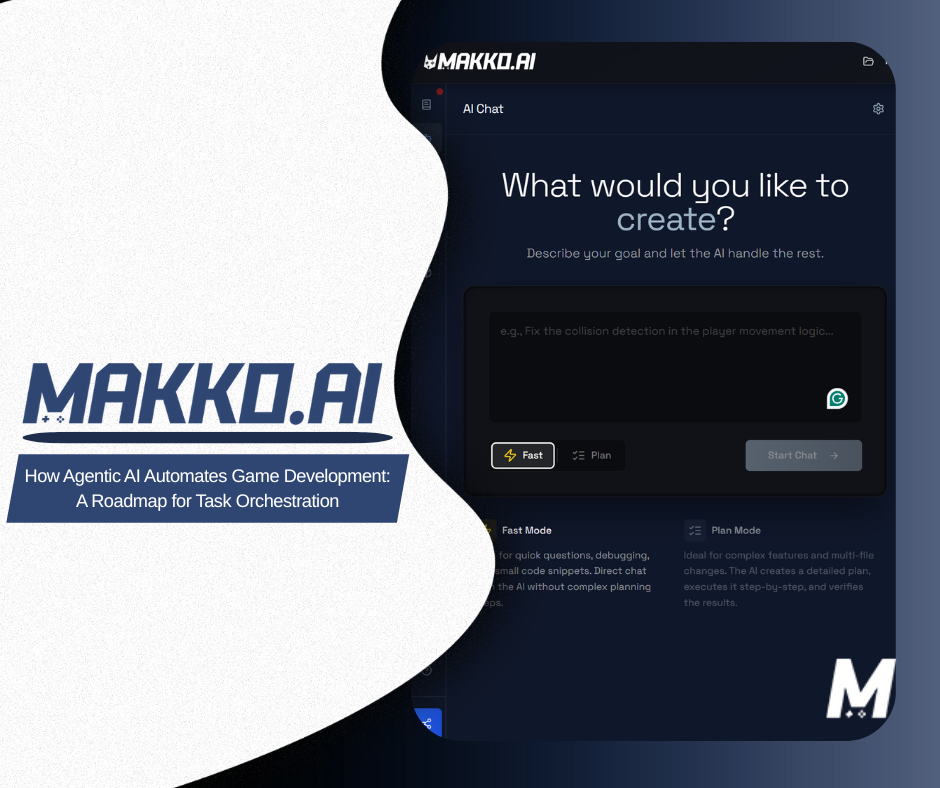
Makko's Plan Mode and Fast Mode reflect this distinction. Plan Mode is optimized for structural and systemic changes. It generates a full breakdown of what it intends to do before making any changes to the project. The developer can read and refine that plan through conversation, and execution only happens after approval. This is the mode for adding a new core mechanic, refactoring a progression system, or making a change that touches multiple interconnected systems simultaneously.
Fast Mode is optimized for speed: low-latency execution for changes that are well-scoped and unlikely to have broad systemic effects. Visual adjustments, minor behavior tweaks, asset swaps, and other targeted changes do not benefit from the full dependency mapping that Plan Mode provides. Fast Mode handles these without the reasoning overhead that would make simple changes feel slow.
The concept behind this distinction is that the reasoning time assigned to a task should be proportional to the task's complexity. Allocating heavy reasoning to a simple change wastes time. Allocating light reasoning to a complex change risks missing dependencies and introducing inconsistencies. Calibrating correctly between Plan Mode and Fast Mode is one of the practical skills of working effectively with an agentic development environment.
What Agentic AI Does Not Automate
Being precise about the boundaries of agentic automation matters as much as describing its capabilities. Agentic AI automates the coordination, implementation, and consistency management layers of game development. It does not automate the creative decisions that determine whether a game is worth playing.
The question of what a game should feel like, what the core loop should reward, how challenge should be paced, whether the moment-to-moment interaction creates the emotional experience the creator is aiming for, remains entirely in the creator's domain. Agentic game development gives creators more time and energy to spend on those decisions by reducing the amount of time and energy required for everything else. It does not make those decisions for them.
Similarly, agentic automation does not replace the judgment that comes from actually playing the game and responding to what it feels like. Playtesting, real human engagement with a game in a play session, remains the irreplaceable mechanism for understanding whether a design is working. What agentic AI provides is the ability to reach testable builds faster and iterate on them with less friction, which means more playtesting cycles are available within the same time budget, not that playtesting becomes unnecessary.
The workflow accelerator framing is precisely this: agentic tools reduce administrative toil and technical overhead, not creative direction. The creativity, the taste, the vision belong to the creator. What changes is how much of the available time and energy goes toward exercising them.
The Shift That Is Already Happening
Agentic AI in game development is not a future capability being previewed. It is the production model that AI-native game development is built on today. The transition from instructional automation to goal-oriented orchestration changes the nature of what a creator needs to do at every stage of the pipeline: from setup through iteration, debugging, and publishing.
For creators who have historically been blocked from building the games they had in mind, by the technical prerequisites of traditional engines, by the coordination overhead of manual scripting, by the fragility of codebases that become harder to change as they grow, agentic orchestration removes the obstacles that were never really part of the work. The current development environment rewards creators who can validate ideas quickly, iterate without fear, and get to what is actually fun before the window closes. Agentic AI is the mechanism that makes that pace achievable.
Frequently Asked Questions
What is agentic AI in game development?
Agentic AI in game development refers to systems that understand goals, plan the actions required to reach them, and carry out those actions across multiple steps while adapting as conditions change. Unlike instructional automation, which executes a fixed sequence of steps, agentic AI interprets what a creator wants, identifies what systems need to be built or modified, determines the correct dependency order, and handles the implementation. This shifts the creator's job from specifying every implementation step to describing the intended outcome.
What is the Boilerplate Wall and how does agentic AI solve it?
The Boilerplate Wall is the accumulation of technical prerequisites that stand between a game concept and a first playable build: project initialization, physics configuration, input mapping, state machine construction, UI wiring, and all the setup that must be completed before any actual game design can be tested. Agentic AI solves this not by making each step faster, but by eliminating them as the creator's responsibility. When a creator describes a game concept, the agentic system handles structural assembly and produces a playable build without requiring the creator to specify each implementation step.
What is system orchestration in an AI game development context?
System orchestration is the automated maintenance of dependency relationships between game systems as a project evolves. In a manually scripted project, when a mechanic changes, every system that depends on it must be traced and updated by hand. An agentic orchestration layer maintains a live understanding of the project's current state and propagates changes consistently across all affected systems automatically. When a creator adds regenerating health, for example, the orchestration layer identifies that health state is read by the UI, the save system, and the death condition, and updates each of them as part of the same operation.
What does agentic AI not automate in game development?
Agentic AI automates the coordination, implementation, and consistency management layers of game development. It does not automate the creative decisions that determine whether a game is worth playing: what the core loop should reward, how challenge should be paced, whether the moment-to-moment interaction creates the experience the creator is aiming for. Those decisions remain entirely in the creator's domain. Agentic AI gives creators more time and energy to spend on those decisions by reducing the time required for everything else.
What is the difference between Plan Mode and Fast Mode in Makko?
Plan Mode is Makko's high-reasoning-depth environment. It generates a structured plan before making any changes, allowing the developer to read, refine, and approve it through conversation before implementation begins. It is designed for complex, multi-system changes where upfront planning prevents downstream inconsistencies. Fast Mode skips the planning phase and applies changes immediately, optimized for simple, well-scoped tasks where immediate execution is more valuable than pre-implementation review.
For detailed walkthroughs and live feature demos, visit the Makko YouTube channel.