
How Many Backgrounds Does Your Game Actually Need?
A location is perceived, a background is paid for. How to derive your own count, and the reuse multipliers that pull those two numbers apart.
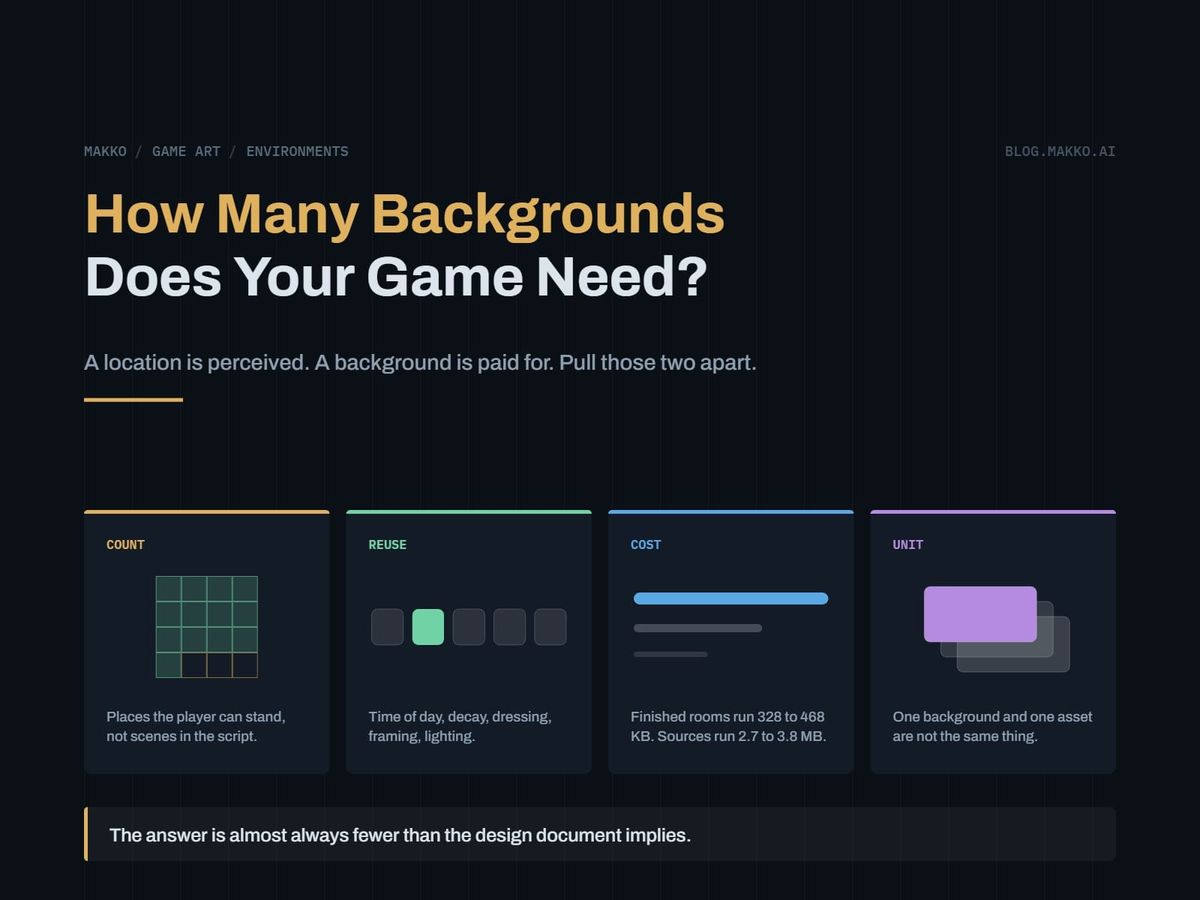
Your design document has a location list. Count it, multiply by what one painted room costs in weeks or in money, and you have the number that decides whether the game ships. Almost nobody runs that multiplication before the design locks.
Background count is the largest line in a 2D art budget, larger than the whole cast, and the one most often set by accident. The script grows a scene, the scene gets a place, the place gets a background. Nobody deletes one.
Two numbers hide in that list: the places the player perceives, and the pictures somebody has to paint. They can sit one to one, or four to one. What follows is the arithmetic, then a table, then the multipliers that pull them apart.
The short version. Count distinct places the player can stand and take input, not scenes in the script, then divide by the variants you can pull from each painted room. Dressing, prop swaps, camera crops and engine lighting are close to free, and each reads to a player as somewhere new. Baked damage states and any change to the walkable area are new rooms wearing a variant's name. Most projects need about half the backgrounds their design document implies.
A location is perceived, a background is paid for
Hold these two units apart. Every scoping mistake in 2D art comes from collapsing them.
A location lives in the player's head. The mess hall. The mess hall after the fire. The mess hall at night with the lights down. Three places, to the player. A background is a file you paid an artist for. In that example it is one background, one overlay and one color grade.
The arithmetic is one line. Backgrounds equal distinct places divided by the average number of locations you pull from each one. Everyone works on the numerator. The money is in the denominator.
Rooms are cheap to differentiate and expensive to build. Repainting a room costs what the first one cost. Changing the props, the light and the camera costs a fraction and moves the player's read of the space almost as far. A denominator of 1.0 means full price for every location. A denominator of 2.0 means the same game for half the art.
Count places the player can stand, not scenes in the script
A script counts story beats. Art costs places. Run this pass before commissioning anything.
- List every place the player can stand and give input. Places they only watch are a cheaper line item: one angle, no walkable area, no collision.
- Collapse by story beat. The bridge in act one and the bridge in act three is one place. If only the dialogue differs, it is not a second background.
- Record minutes per place, not scenes. That column decides where the money goes, and it usually inverts the script's emphasis.
- Group by architecture. Same floor plan, same walls, same band of screen the character walks along. Four corridors with different signage are one corridor.
- Name the base and the variants in each group. A group with no variants is a unique room at full price. Be sure you meant that.
Step four is where the number falls. A list of 22 named locations usually resolves into nine or ten architectural families, and families are what you build.
Realistic background counts by game shape
Counts that hold up in shipped games. Read the reasoning rather than the integer: it lets you derive a number for a shape not listed.
| Game shape | Backgrounds | Reasoning |
|---|---|---|
| Single-screen arcade or arena | 1 to 3 | The background is scenery. Variety comes from enemies and hazards, and players stop seeing the backdrop within a minute. |
| Short narrative game, two to three hours | 8 to 12 | One place per chapter, several scenes each. Time of day and dressing carry the beats. Highest reuse ceiling. |
| Point-and-click adventure | 15 to 25 | The background is the puzzle surface. Players stare at it hunting hotspots, so dressing tricks get caught. Lowest reuse ceiling here. |
| Platformer or metroidvania | 4 to 8 biome sets | The unit is not a room. Parallax sets repeat across dozens of screens and level design makes the variety. Counting screens gives a number ten times too large. |
| Roguelike with generated levels | 3 to 6 kits | A kit is tiles plus transitions plus props. Generation differentiates for free. |
| Story RPG, ten to twenty hours | 20 to 35 | Towns are painted, dungeons are kits: two budgets stapled together, and mixing them is how this shape overruns. |
If your shape is not listed, take the row whose unit matches yours. The split that matters is painted rooms against kits: estimating a kit as though it were a painting is the fastest route to double the forecast.
The reuse multipliers, and what each one costs
Five things turn one background into several perceived locations. They do not cost the same, and the two expensive ones get sold internally as free.
Dressing and prop swaps. Nearly free, and the strongest of the five. Props are separate sprites already, they repeat across rooms, and they are the first detail a player reads. Crates and a workbench make a hold; bunks and a footlocker make quarters. Budget props by the set: thirty objects dress a whole game.
Camera framing. Free if you authored with headroom, a repaint if you did not. A background painted wider than the shipping frame gives you crops, pans and pushes at no extra cost. That is the whole argument for authoring above target. Paint to the exact frame and every angle is a new commission.
Engine lighting. Nearly free, with one condition. A 2D light, an additive glow, a grade over the scene: all runtime, free per room. The condition is shadows. If a lighting change would move shadows already painted into the background, the engine cannot sell it and you are looking at a repaint. Keep baked shadows soft in rooms you intend to relight.
Time of day. Free as a grade, expensive as a repaint. Day to dusk is a tint and a warmer key. Day to night is often a different painting, because at night the light sources move into frame: windows, lamps, screens. The two requests sound identical in a brief and differ by a full room in cost.
Damage and decay states. The expensive one, mislabeled. Debris, scorch and cracks laid over the same base as overlays are cheap and read hard. A room whose structure changed, a collapsed ceiling or a blown-out wall, is a second painting with a first painting's name on the ticket. The test is mechanical: if the architecture's silhouette changes, it is a new room.
That test generalizes. A variant that changes the walkable area is not a variant. It changes collision, navigation, where props sit, and the band of screen that stays clear. You pay in level design as well as art.
What one room costs on disk and in memory
Numbers from one shipped room set, the Sector Scavengers collection.
| Asset | Resolution | File |
|---|---|---|
| Hallway front background | 1920 x 1080 | 328 KB |
| Fixed bridge background | 1920 x 1080 | 432 KB |
| Mess hall front background | 1920 x 1080 | 468 KB |
| Hallway, wide source | 2560 x 1440 | 2,705 KB |
| Origin warehouse panel | 2560 x 1440 | 3,818 KB |
| Hallway middle section | 2048 x 2048 | 2,180 KB |
Finished 1920 x 1080 rooms land between 328 and 468 KB. The 2560 x 1440 sources run 2.7 to 3.8 MB. Pixel count rises about 1.8 times and file size roughly eight, because the finals are flattened and optimized and the sources are not. Ship the finals: twelve finished rooms is around 5 MB, twelve sources is 40 MB.
Video memory bites harder. An uncompressed 1920 x 1080 background is 7.91 MiB resident, against 2.38 MiB for a 600 x 1040 character sheet: one room is roughly three and a half sheets. On disk, one 2560 x 1440 background costs about what a whole six-sheet animated character costs, around 3 MB. Rooms are the memory problem in a 2D game, not the cast. The same arithmetic decides how large a sprite sheet can get before it stops fitting. Load rooms per scene and unload them.
One background is not one asset
One corridor in that set is twelve assets. Not twelve attempts at a picture: twelve pieces of one deliberately layered room.
The structure is middle sections that carry the corridor, plus top and bottom transition pieces framing the play space, plus variants of each. The top and bottom pieces are authored with the middle left empty, so the band where characters walk stays clear and framing art never competes with gameplay. Middle sections are square at 2048 x 2048 while the assembled room ships at 1920 x 1080.
Read what that buys. The corridor can be short or long, capped with different framing at either end, walk band clear in every combination. One room, twelve production items, any number of corridors.
This is a unit problem. Say which unit you are counting every time you state a number. Twenty perceived locations, nine base rooms and thirty delivered assets can be three true statements about one game, and a schedule built on the first is wrong by a factor of three.
Scoping a real game, end to end
Follow along with your own list open. A salvage game, art bought in.
Start. The design document names 22 locations. Collapse by story beat. Seven are the same places at different points in the story. Down to 15.
Group by architecture. Four are corridors. Three are crew cabins on one floor plan. Two are cargo holds, intact and wrecked. Six are genuinely different: bridge, mess hall, engine room, medbay, airlock, derelict exterior.
Assign bases and variants. One corridor kit, one cabin base with three dressing sets, one hold base plus a debris overlay, six unique rooms. That is nine base backgrounds producing fifteen perceived locations, a denominator of 1.7.
Push the denominator. The bridge gets an alert state from a runtime tint. The mess hall gets a night pass and a dressing change after the crew leaves. The derelict exterior is authored at 2560 x 1440 and cropped three ways: approach, dock, departure. Still nine backgrounds, now reading as twenty locations.
Cost it. Nine finished rooms at 328 to 468 KB is 3 to 4 MB shipped. The corridor kit is twelve assets by itself, so the delivery count is nearer thirty than nine. Schedule against thirty. Talk to players about twenty.
The background budget template
Fill every field before anyone paints. A blank field is a decision you have not made.
# [GAME] - Background Budget v0.1

## Counting unit (state all three, always)
perceived locations : [n]   what the player believes exists
base backgrounds    : [n]   what gets painted
delivered assets    : [n]   pieces, layers, variants

## Per place
place          base  variants          source            minutes
bridge         1    alert state       runtime tint         40
mess hall      1    night + dressing  tint + props         25
corridor kit   1    12 pieces         tiles + transitions  90
cargo hold     1    wrecked           debris overlay       15
              total 4 base -> 8 perceived locations

## Resolution policy
authored : 2560 x 1440   crop and camera headroom
shipped  : 1920 x 1080   flattened, optimized
tiles    : 2048 x 2048   square, repeatable

## Disk and memory check
finished room : 328-468 KB -> [n] x 0.4 MB = [ ] MB shipped
source file   : 2.7-3.8 MB each, archive only
resident room : 7.91 MiB -> [n] x 7.91 = [ ] MB
platform texture budget : [ ] MB

## Rules art must follow
- middle band stays empty on top and bottom framing pieces
- baked shadows stay soft on any room that will be relit
- a variant that changes the walkable area is a new room
The rules block belongs in your art bible too. Reuse rules are style rules: they decide what the game looks like, not only what it costs.
When a unique room earns its cost
Everything above pushes toward reuse. Here reuse is the mistake.
- The place the player returns to most. A hub, a ship, a home base. It absorbs more screen minutes than three story rooms combined.
- The first minute and the last. Opening rooms set the standard everything else is graded against. Ending rooms are what players remember.
- Rooms where the background is the mechanic. A puzzle surface, a map screen, anything scanned rather than crossed.
- Any place whose walkable shape differs. You are building a new room in level design regardless, and reusing the art pins the layout to a plan drawn for something else.
- The room that carries a story turn. Players accept reuse everywhere except where the narrative insists something changed.
- Screenshot rooms. Store page, trailer, press kit. Pick three in advance rather than finding at launch that your best room is a corridor.
Note what is missing: corridors, transit spaces, rooms visited once, anything behind a cutscene. Cutting those to base plus dressing costs nothing a player will name. If you are still choosing how to source it, the decision tree for getting art made runs on these counts.
Frequently asked questions
How many backgrounds does a short narrative game need?
Eight to twelve base backgrounds covers a two to three hour game, one per chapter with several scenes each. If your script implies thirty, run the collapse pass first: story-beat duplicates alone usually remove a third of the list.
Can I ship one background and change the lighting?
For a single-location game, yes, and good ones have. The limits are shadows and silhouette. A runtime tint sells a new time of day for free, but painted shadows fight any key light you move, and the room's shape does not change whatever color you throw at it. Plan on dressing and framing doing as much work as the light.
What resolution should backgrounds be?
Ship 1920 x 1080 flattened for a 1080p target and author above it, at 2560 x 1440, for crop and camera headroom. Tiling pieces are authored square at 2048 x 2048 because they repeat in both directions. Optimization matters more than pixel count: same image, 1.8 times the pixels, eight times the file.
How do I keep reused rooms from looking reused?
Change three things at once, never one. New props plus a different crop plus a lighting shift reads as a new place. Any one alone reads as the same room with a filter. Vary what the player does there too: a room used for a conversation and later for a chase registers as two places.
Why does this say MiB and not MB?
Because memory and storage are counted in different bases. A mebibyte, MiB, is 1,048,576 bytes, or two to the twentieth. A megabyte, MB, is 1,000,000 bytes. Memory is physically addressed in powers of two, so every engine profiler reports the binary figure, and the numbers here match what Godot, Unity or Unreal will show you. Storefronts and drive manufacturers use the decimal one instead. At this scale the two differ by about five percent, so the same 1920 by 1080 background is 7.91 MiB and 8.29 MB. Same pixels, two labels. It is the same reason a drive sold as 1 TB shows up as 931 GB.