
The Idle Animation You Cannot Cheap Out On
The animation with the most screen time in your game is the one built last and fastest. How to build it properly instead.
Your character is standing in a shop menu. The player is comparing two swords, reading, deciding. Ninety seconds pass. The only thing moving on screen is the idle, and you specified it in six words at the bottom of a list, after the attack, after the death, after a second attack you have not built yet.
That order is backwards. The idle has the most screen time in almost every 2D game and gets built last and fastest. This article settles what an idle has to do, how many frames it needs, which motion buys the most per frame, and how to hide the loop after four hundred repetitions.
You do not need to draw any of it. You need to specify it and judge it.
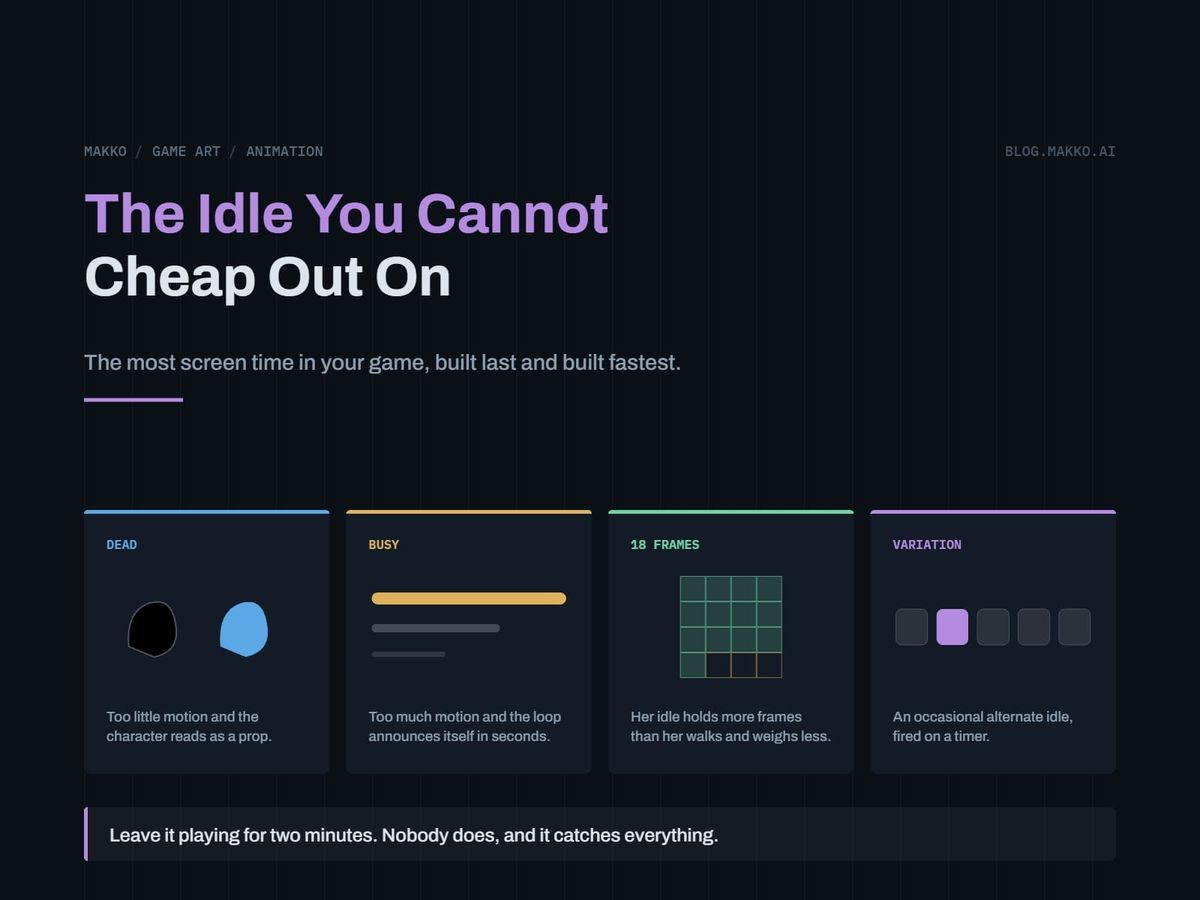
The short version. An idle is not the character standing still. It tells the player the character is alive, under their control, and currently in some state, while nothing else is happening. It fails in two opposite directions: too little motion reads as scenery, too much makes the loop obvious in seconds. Spend the frames on breathing at the shoulders plus one trailing secondary element, keep the loop featureless rather than long, add a variation idle on a randomized timer, and judge it by leaving it playing two full minutes.
The idle outweighs the rest of the set on screen time
Count it from your state machine, not from imagination. Idle plays during every dialogue box, every inventory screen, every pause, every moment of deciding where to go, every gap between inputs. Across a one hour session the ratio of idle screen time to death screen time lands near 120 to 1, and the same arithmetic puts idle well ahead of your primary verb.
Two things push the real number higher. Idle is the fallback, so it also covers every state your code enters without dedicated art: stunned, talking, shopping. And the most-viewed frame in the set is the idle's first, the pose every other animation snaps to when it ends. A stiff first frame means every walk and attack ends on stiffness.
The cost side makes cheaping out indefensible. Mira Hearthkeeper, in Wayfarer's Hearth, ships six baked sheets. Her idle holds 18 frames in a 5 by 4 grid of 119 by 260 cells, at 361 KB, against 13 frames on each of her three walks. Five more frames than any walk, and still the smallest file of the six, because an idle needs almost no lateral room: 119 px of cell width against 221 on her celebrate. Per frame, the cheapest sheet in the set.
An idle communicates three things, and you built one
Alive. Everybody builds this. Motion in the silhouette separates a character from a prop. Without it, players walk past your NPC, having read it as set dressing.
Under player control. Continuous motion proves the game has not frozen and input is still being read. Invisible until it fails: when your game hitches for 400 ms, a moving idle reads as a hitch and a static idle reads as a crash. It is also why an idle should never hold long on one frame. A two second hold inside the loop is indistinguishable from a lockup.
Current state. Almost nobody builds this, and it is where idles earn their keep. A player looking up after glancing away should be able to tell from the idle alone whether their weapon is drawn, whether they are hurt, whether they are carrying something. A combat idle with a raised guard beats any number of status icons, because it sits where the player's eyes already are.
The dead idle and the busy idle
The dead idle. The tell: pause on a random frame, pause on another, compare the two silhouettes. If you cannot tell them apart, the motion is interior only, a shading shift on the chest or a two pixel head bob the outline never registers. At play size, interior motion disappears first.
The busy idle. The tell: watch five seconds and try to name the loop point. If you can, it is too busy. The cause is a distinctive peak, a big shoulder roll or a head turn or a weapon flourish, and that peak becomes a metronome. The second symptom is worse: the motion pulls the eye off whatever the player is reading. Against a dialogue box the idle loses, and the player reads it as noise.
The band between them is describable. Motion must show in the silhouette and must never be the fastest moving thing on screen. Quicker than the ambient motion behind the character is too busy. Slower than a person breathing in a queue is dead.
Motion sources ranked by cost against payoff
You are buying frames. Spend in this order, and stop when the budget runs out.
- Breathing at the chest and shoulders. The best purchase in the whole animation set: one oscillation between two extremes, and it buys "alive" outright. The requirement is that it moves the shoulders, because shoulders sit on the silhouette and the chest often does not.
- One secondary element. Hair, a scarf, a cloak hem, a tail, a held lantern. It adds motion at the edge of the figure where the eye picks it up cheaply, and because it trails the body by a beat it produces follow-through, the one animation principle non-animators reliably perceive. It can also run a longer cycle than the breath, the cheapest loop obscurity available.
- Weight shift. Hips and ribcage move laterally, head counterbalances, and the character reads as waiting rather than standing. Expensive: the whole body reposes with both feet planted. Buy third, for a high screen time character only.
- Blink. One or two frames, conditional. If the eye is a couple of pixels at play size, spend those frames on the secondary element instead. Blinks pay heavily at dialogue scale.
- Full-body settle. A shift of stance, a look around, a strap adjustment. Not part of the base idle. Put it in the variation idle below.
With six frames total, spend all six on breathing plus a trailing secondary element. No blink at six frames, no weight shift at twelve.
The loop visibility problem is the real engineering
Do the arithmetic once and the rest follows. Eighteen frames at 12 fps is a 1.5 second loop. A player sitting in a menu for one minute sees it forty times, and across a session, hundreds. Nothing else in your game gets inspected that many times.
Longer is not automatically better. Detectability comes from landmarks, not duration. A four second loop with one distinctive frame reads as a loop faster than a one second loop with none, because the eye latches onto the landmark and starts counting. Doubling the frame count without removing the landmark doubles cost and only halves the reminders. Remove the landmark instead: motion continuous, extremes gentle, no frame standing out from its neighbors.
Run the idle at a lower frame rate than your other animations. Same frames, longer loop, no extra art. Half your walk's rate is legitimate, because the motion is genuinely slow and the eye reads it as slow movement rather than missing frames. Two conditions: it has to be a number in your spec rather than an accident, since an unplanned mismatch between idle and walk reads as a defect, and the idle needs enough frames to stay smooth, because four frames at half rate is a slideshow. Rate is set per animation at import, and the per-engine import settings differ in where that field lives.
The variation idle is the standard solution. One short alternate fires on a timer while the character stays idle, then returns to the base loop. Four rules:
- It begins and ends on the base idle's first frame, so it splices in and out without a pop.
- Fire it on a randomized interval. A variation that fires every eight seconds is just a slower loop.
- Keep it short. A long one reads as a cutscene the player did not ask for.
- Build it after the base idle is good, or you get a statue that twitches occasionally.
One more fix costs a line of code and no art: randomize the entry frame per instance. Two guards flanking a door breathing in unison is the most avoidable failure in 2D games. Offset them and one sheet reads as two people.
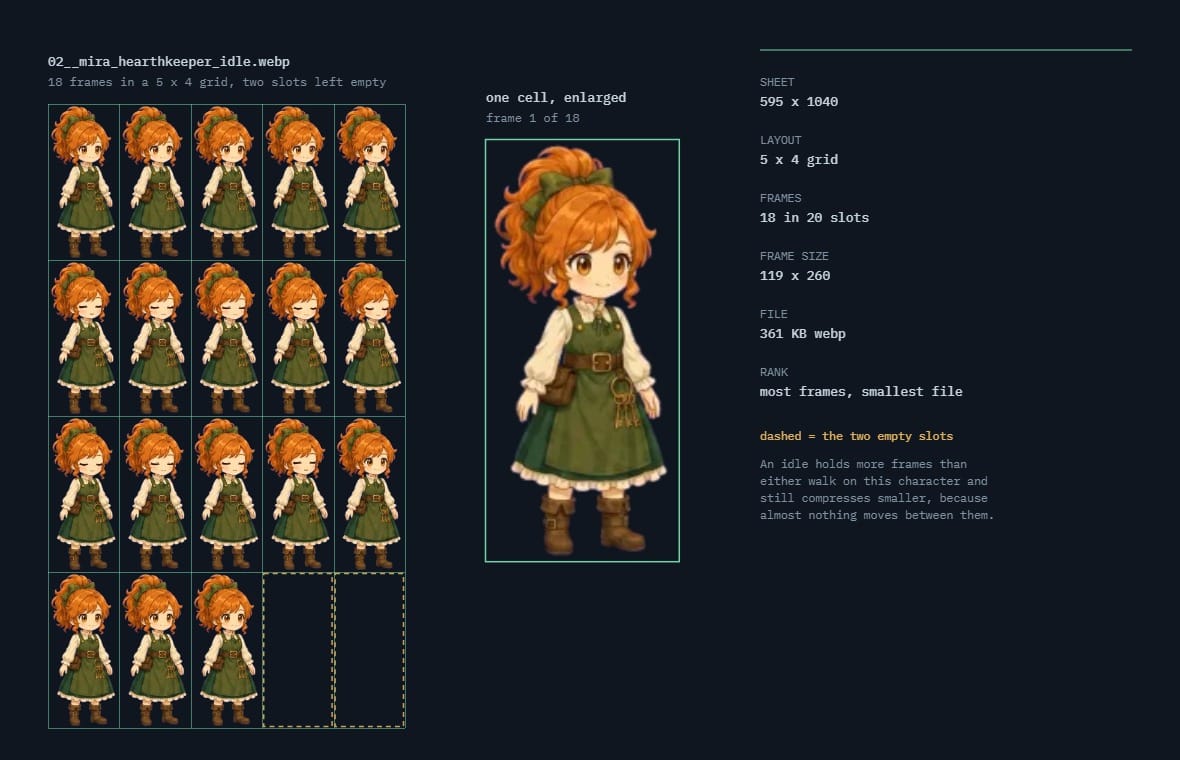 02__mira_hearthkeeper_idle.webp595 × 1040 · 5 × 4 grid · 18 frames in 20 slots · 361 KB
State idles, and how to stop the set from exploding
The state idles a game genuinely needs are a short list: base, armed, hurt, carrying. Most games need two of the four. Pick them from the states your gameplay asks the player to read quickly under pressure.
The explosion is combinatorial. Armed by hurt by carrying is eight combinations, times the directions your camera demands, and a character shipping three locomotion sheets now needs twenty-four idles. Three ways out, in order of preference:
- Pick one axis. Build state idles on the single axis your gameplay reads most and leave the rest out of the idle. In a combat game that is armed. In a hauling or crafting game it is carrying. One, not two.
- Layer instead of baking. Put the held item, weapon or carried box on a separate sprite anchored to a point on the body, so one idle serves every variant. That is four sheets instead of forty, and you decide it before the art is ordered.
- Let the other animations carry it. If the hurt state has its own hit reaction and walk, the player already knows.
A usable ceiling: state idles per character should not exceed the number of locomotion sheets you ship. Mira ships three walks, so three idle states is her bound, base included.
Every alternate inherits the base idle's cell contract: identical cell height, the same gap from art bottom to cell bottom, and its own frame count stated separately from its slot count. Mira's idle is 18 frames in 20 slots, and an alternate that quietly plays two empty trailing slots gives you a blank flicker on a loop the player sees hundreds of times. Put cell height and ground gap in the order the way the sheet spec handles padding. Sheets baked as one collection, as Makko does, come out of that contract together.
The two minute test catches everything, and nobody runs it
You cannot animate, so you judge by watching. Leave the idle playing two full minutes and look at it. Everyone reviews an idle for six seconds, decides it is fine, and ships a loop the player sees four hundred times.
- Scale the character to play size, at the final frame rate.
- Put two copies on screen with different start frames, and a third beside another character.
- Start a two minute timer and watch without touching anything.
- Write down the loop point when you find it. Before thirty seconds means too busy.
- At the end, name the three things that move. Fewer than three means dead.
Two minutes catches what six seconds cannot: the landmark frame turning into a metronome, the blink firing at the same instant every cycle, the hair snapping back rather than settling at the seam, the pixel of anchor drift, and interior-only motion that vanishes once you stop staring. As in the programmer's overview of game art, checks you can run without craft knowledge catch the defects players feel.
The idle spec block to copy
Fill this in before anyone draws a frame, then paste it into your art order.
# [CHARACTER] - idle spec

BASE
  loop [   ] s   fps [   ]   frames [   ] (not slots)
  cell [ w ] x [ h ] px, height matches every sheet
  art-to-bottom gap [   ] px +/- [   ]

MOTION, PRIORITY ORDER
  [x] breathing, chest + SHOULDERS (move the silhouette)
  [ ] secondary [ hair / cloth / item ], cycle > breath
  [ ] weight shift, feet planted
  [ ] blink -> only if the eye reads at play size
  [ ] NO full-body settle in the base loop

LOOP RULES
  no frame distinct from its neighbors
  no hold over [   ] ms
  last-to-first delta = any adjacent pair

VARIATION
  fires [ min ]-[ max ] s, randomized
  [   ] s, starts and ends on base frame 1

STATE IDLES (ceiling = locomotion sheet count)
  [ ] base [ ] armed [ ] hurt [ ] carrying
  inherit cell height + ground gap

CODE: randomize entry frame per instance

ACCEPTANCE
  play at final size and rate, 2 min, unattended
  reject if loop point nameable inside 30 s
  reject if under 3 moving parts nameable at the end
Frequently asked questions
How many frames should an idle be?
Decide loop duration first, then multiply by frame rate. A breath cycle around two seconds reads as calm and under one second reads as agitated, so duration is a character decision, not a budget one. For scale, a studio bake ran Mira's idle to 18 frames against 13 on each walk. An idle with fewer frames than your walk is under-ordered.
Can I just use two frames and swap between them?
For a background NPC at small scale, yes, and it beats no idle. For anything the player controls or talks to, no. Two frames produce a pop rather than motion, and a pop is a landmark, so the loop reads instantly. At a genuine two frame budget, spend them on a secondary element at the edge of the silhouette rather than on the body.
Does the variation idle need its own sheet?
It can live on the base idle sheet if the grid has room, which is cheaper: one texture bind, one cell contract. Either way, state the ranges separately, base as frames 1 to N and variation as N+1 to M. Do not let the two share a range and trust the engine to stop in the right place.
Should I fix the idle before or after the rest of the set?
Before, with one exception. The idle sets the frame every other animation returns to, so a rigid idle contaminates the ending of everything else, and fixing it later means re-checking the seam on every sheet. The exception is a game still deciding its primary verb: if the stance will change with the combat design, order a placeholder, ship the verb, and order the real idle once the stance settles.