Game Art for Programmers: A System, Not Encouragement
The standard advice is use cubes, pick a genre without art, or spend two years learning to draw. Here is the other answer: convert the aesthetic problem into a spec problem you can already verify.
Search this and the advice is remarkably consistent: use primitive shapes, pick a genre that does not need art, or set aside two years to learn to draw. All three are answers for someone with unlimited time, which is not the person asking.
The useful reframing is that art is mostly not a drawing problem. It is a decision problem with a small drawing problem inside it, and programmers are unusually good at decision problems once somebody tells them which decisions exist.
The short version. You cannot reliably judge whether art is beautiful. You can absolutely verify whether it is 1024×1024, whether the outline is closed, and whether the character is twice the saturation of the background. Convert the aesthetic problem into a spec problem and you can ship consistent art without developing taste first. Constraints are the substitute for taste, and they are written in a language you already speak.
Why the usual advice fails
Three recommendations dominate, and each has a specific failure.
"Use primitive shapes." Fine for a prototype, and it caps what you can ship. Geometric abstraction is a legitimate art direction, but only when chosen deliberately and executed with real attention to color and composition. Chosen by default, it reads as unfinished, because it is.
"Pick a genre that does not need art." There isn't one. Text games need typography and layout. Puzzle games live or die on readability. Every game is looked at.
"Learn to draw." The best long-term answer and the worst answer to the question asked. Someone with a working prototype and eleven free hours a week is not going to solve this with a two-year skill acquisition, and telling them to is a way of declining to answer.
What is missing from all three is the observation that most of the consistency problems in game art are not caused by insufficient drawing skill. They are caused by nobody having written down what the art is supposed to be.
What you are bad at, precisely
Be precise about the deficit, because it is narrower than it feels.
As a programmer with no art training you are usually bad at generating, at putting a line where it needs to go. You are typically fine at noticing, at seeing that two assets do not belong together, even without being able to say why.
That gap matters, because the whole discipline of art direction runs on noticing rather than generating. Art directors mostly do not draw. They decide, compare, and reject.
The trap is that noticing is unreliable when it stays a feeling. "Something's off about this one" does not survive contact with a deadline, and it cannot be delegated or automated. So the job is to convert each thing you notice into something checkable, once, and then stop relying on the feeling.
Constraints as a substitute for taste
Here is the substitution in practice. Left column is what an artist would perceive. Right column is what you can verify without perceiving it.
| What an artist sees | What you can check instead |
|---|---|
| "The character gets lost against that background" | Mean saturation of the character is less than 2× the mean saturation of the room |
| "These two don't feel like the same game" | Different canvas size, different outline weight, or a palette hex that appears in one and not the other |
| "The lighting is inconsistent" | Highlight is on a different side in asset A than asset B |
| "It reads as muddy" | More than four tones inside a single material region |
| "The silhouette isn't strong" | Fill it 100% black and show someone. They name it in under three seconds, or it fails |
| "That detail is wasted" | The detail is smaller than the character's hand at ship size |
Every row on the right is a predicate. Some are literally scriptable, since saturation ratios and canvas sizes are arithmetic on pixel data. The rest are one-line questions someone can answer without training.
This is the whole method. It does not make you an artist. It makes the absence of one survivable.
The four routes, with real trade-offs
There are four ways to get art into your game, and most projects use more than one. Costs vary enormously by scope, style and who you ask, so treat what follows as shape rather than quotation.
| Route | Costs you | Consistency | Best for |
|---|---|---|---|
| Asset packs | Money, modestly. Time spent searching, which people underestimate badly | High within a pack, poor across packs | Prototypes, and any genre where a single pack covers most of your needs |
| Commissioning | Money, substantially. Plus briefing and review time you cannot delegate | Highest, if you brief well | The handful of assets players look at longest: main character, key art |
| Making it yourself | Time, a great deal of it | Naturally high, because it is one person's hand | Small-scope games, and anyone who wants to learn |
| Generating it | Money, modestly. Time on iteration and review | Depends entirely on whether you constrained it | Wide scope with a small team, where volume is the constraint |
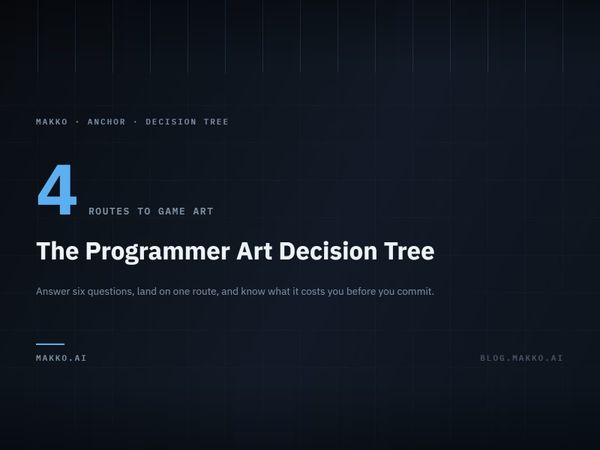
Read the consistency column carefully. It is where projects come apart. Buying three asset packs from three creators gets you three games' worth of art. Generating forty assets across six weeks without fixed rules gets you the same problem from a different direction. The decision tree puts the four routes side by side on money, time and consistency.
The mixing rule
If you use more than one route, and you probably will, start with whichever route produces your most-looked-at asset, then make everything else match it.
Concretely: if the main character is commissioned, the commissioned character sets the palette, the outline weight and the light direction, and every asset pack and generated asset afterward is selected or produced to fit those. Reversing that order means retrofitting your most expensive asset to match your cheapest, which is exactly backwards.
The five decisions to make before any art exists
These are cheap now and expensive later, which is the definition of something to decide up front.
- Canvas size per asset class. One number for characters, one for props, one for backgrounds. Not negotiable per asset. The most common failure is discovering at asset forty that three background sizes are in circulation and you are rescaling in the engine instead of shipping.
- Light direction, stated from the artist's point of view. Every published art bible bothers to disambiguate this, because "upper left" is meaningless once a character turns around. Pick one. It does not matter which.
- Outline rule. Present or absent, one weight, and whether it scales with canvas so a 512 prop and a 1024 character read the same at ship size.
- The separation rule. How much more saturated characters are than the environments they stand in, and which one you adjust when they collide. Adjust the environment. Always.
- Naming convention. Class segment first so the directory sorts by type. Ten minutes now, an afternoon later.
None of these require taste. All of them are the sort of decision you make twenty times a day in code.
 Ruby305 × 560560 tall
 Roger295 × 560560 tall
 Lucas311 × 560560 tall
 Marge303 × 560560 tall
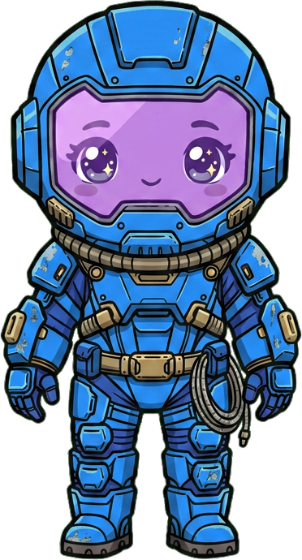 Biff302 × 560560 tall
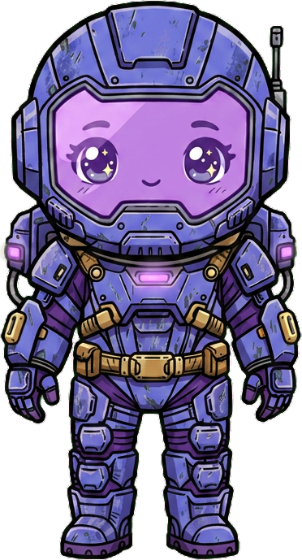 Yuri302 × 560560 tall
The three tests
Run these before an asset is accepted. They take about two minutes combined and they catch most of what an art director would catch.
Silhouette. Fill the asset 100% black. Show it to someone on the team. They name it correctly within three seconds, or the shape is not doing its job. This test is brutal and almost never wrong.
Ship size. Scale it to the size it appears at in game, then sit back to normal viewing distance. Most detail arguments dissolve here. So does most of the case for spending another hour on it.
In situ. Composite it onto your brightest environment and your darkest one, side by side. This is the test that catches separation failures, and it needs human eyes rather than a script. Run it against your two extremes rather than a mid-tone scene, because anything holding up at both ends holds up everywhere between.
Silhouette
Fill it 100% black and show it to someone on the team. They name it correctly within three seconds, or the shape is not doing its job.
Ship size
Scale it to the size it appears at in game, then sit back to normal viewing distance. Most detail arguments dissolve here.
In situ
Composite it onto your brightest environment and your darkest one, side by side. This is the test that catches separation failures.
Where to spend money instead of time
Assuming a limited budget, the ordering that returns the most:
- The main character. Highest screen time, highest emotional weight, and it sets the rules everything else follows.
- Key art. The store page image does disproportionate work. It is the only asset seen by people who have not played the game.
- UI chassis. Interface art is looked at constantly and is the section most likely to be neglected. It is also unusually systematizable: one frame language, applied everywhere.
- Everything else. Props, background dressing, and the long tail benefit least per dollar, because players see them briefly and in aggregate.
The common mistake is spreading the budget evenly across the asset list. Weighting it by screen time is closer to right, and 0 A.D.'s public art document does exactly that with its texture budgets: 64×64 for unit props, 512×512 for structures and terrain, scaled by how much attention each gets.
What this does not solve
Being straight about the limits.
Constraints produce coherence, not distinction. A game that follows every rule above will look like it belongs together and will not necessarily look like anything in particular. Distinction comes from a deliberate art direction choice: an unusual palette, a specific shape language, a rendering approach with a point of view. That is a taste decision no checklist supplies.
What the system buys you is the ability to make that one decision, and then have everything else obey it. Which is a substantially better position than making forty small aesthetic decisions badly.
The one skill to build
If you do decide to invest time rather than money, invest it in comparison rather than production.
Put two assets side by side and force yourself to name one concrete difference, not "this one's better" but "this one's outline is heavier" or "the highlight is on the other side." That habit improves fast, transfers to every route on this page, and makes you a better client, a better filter and a better reviewer without a single hour of drawing practice.
It is also the skill that makes the checks above pay off. A checklist tells you something failed; comparison tells you what to ask for instead.
Where to start this week
Write down the five decisions. It takes twenty minutes and it is the highest-leverage thing available to you.
Then make one asset, the main character, and treat it as the reference for everything after. If you commission it, brief it against those five decisions. If you generate it, constrain it with them. If you draw it yourself, at least you now know what you are aiming at.
Our art bible template is those decisions filled in for a real project with measured numbers, and there is a blank version at the bottom. The production spec covers the engine side, and four teams who published theirs show what the discipline looks like when it is done properly.
Frequently asked questions
Can I make a game without knowing how to draw?
Yes, and most solo developers do. The skill that matters is judging art rather than producing it, and judgment can be replaced with written constraints that anyone can verify without training: canvas sizes, a light direction, a saturation ratio, an outline rule.
What is the fastest way for a programmer to get game art?
Decide the five constraints first, then pick a route: asset packs for prototypes, commissioning for the few assets players look at longest, generation where scope is wide and the team is small. The order matters more than the route. Decide, then acquire, not the reverse.
Should I learn to draw or pay someone?
If you want to make games for years, learn some drawing; it improves your judgment even if you never ship a hand-drawn asset. If you want to ship this game, pay for the assets with the most screen time and systematize the rest.
How do I know if my game art is any good?
Run three tests. Fill the asset 100% black and see if someone names it in three seconds. Scale it to ship size and look from normal viewing distance. Composite it onto your brightest and darkest scenes. Most problems an art director would flag show up in one of those.
Why does my art look inconsistent even though each asset looks fine?
Because consistency lives in the things assets share, not in any individual asset: canvas size, outline weight, light direction, palette, saturation band. Each asset can be internally good while disagreeing with its neighbors on all five.
Is it cheaper to buy asset packs or commission art?
Packs cost far less per asset and cost you consistency across packs, plus more search time than people expect. Commissioning costs more and gives you exactly what you briefed. The usual answer is commissioning the few assets with the most screen time and covering the long tail another way.